ECZEMA
Dr Sami Billal - Phd, MD
Terminology
Dermatitis / Eczema
- Dermatitis = Derma + titis
- Derma: refers to skin; itis: means
- “inflamed”
- - thus, inflamed skin
- - other examples: arthritis, encephalitis.
- Derma: refers to skin; itis: means
- Eczema = Greek term “To boil over”
- Usually refers to severely inflamed dermatitis, and associated signs and symptoms (itching, sting, burning of the skin with drainage from lesions)
Terminology
- The terms ‘dermatitis’ and ‘eczema’ are nowadays generally regarded as the same.
- The term ‘dermatitis’ to include all types of cutaneous inflammation.
- So that all eczema is dermatitis, but not all dermatitis is eczema.
- E.g. Dermatitis Herpetiformis (a bullous disease)
Eczema
- Eczemas are a group of diseases which have different types/skin manifestations
- The patient usually is a known atopic or has a family history of atopy (e.g.Bronchial asthma)
Classification of Eczem - Eczema is divided into two groups:
-
1- Exogenous eczemas
-
Are related to clearly defined external trigger factors
-
Inherited tendencies can also play a part.
Presentations
- Contact dermatitis
- Eczematous polymorphic light eruption
- Infective dermatitis
-
-
2- Endogenous eczema
-
The eczematous condition is not a result of exogenous or external environmental factors
-
Mediated by processes originating within the body.
Presentations
- Atopic dermatitis
- Seborrhoeic dermatitis (dandruff & redness)
- Discoid eczema (very itchy coins)
- Palmoplantar dermatosis
- Pityriasis alba (small white blotches on face)
-
DIAGNOSIS OF ECZEMA
The diagnosis of eczema is usually clinically but in some cases histopathology may be needed to confirm diagnosis.
Clinical Features of Eczema
The lesions of eczema take different forms:
-
In the acute eczema:
- Erythematous papules,
- Vesicles, and
- Oozing with crusting.; cream
-
In the subacute eczema:
- Lesions are reddish with scaly papules.
-
In the chronic eczema:
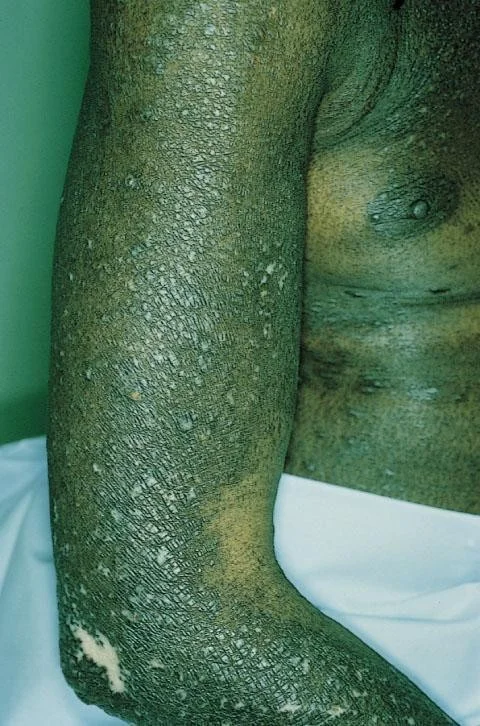
- Chronicity leads to thickened epidermis with accentuated skin markings (lichenification; hyperketatosis).; oitment steroid
Clinical Features of Eczema
- Excoriations due to scratching are the commonest secondary lesions.
- Conditions are usually associated with itching.
- Eczema not associated with constitutional symptoms unless there is secondary bacterial infection
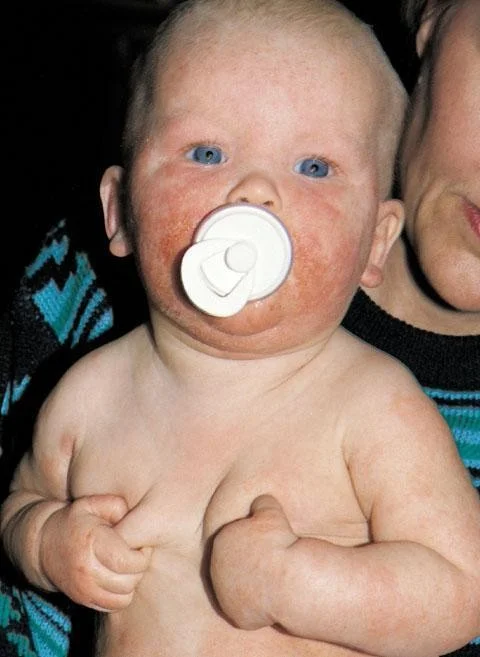
Atopic Dermatitis in an infant -
Chronic Eczema with lichenification
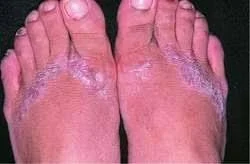
Contact Dermatitis
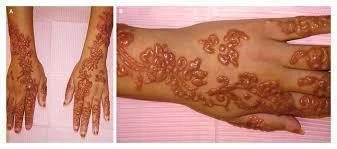
Contact Dermatitis
Histopathology of eczema
- The histopathological features reflect a dynamic sequence of changes resulting from inflammation of the epidermis and the underlying dermal structures.
- These vary with the intensity and the stage of the eczematous process
Histopathological features of eczema
-
- Spongiosis (intercellular epidermal edema) leads to stretching and rupture of the intercellular attachments, with the formation of vesicles → ACUTE ECZEMA*
-
- Increased epidermal mitotic activity leads to acanthosis* → SUBACUTE ECZEMA
-
- Acanthosis is associated with formation of a parakeratosis* → CHRONIC ECZEMA
Treatment of eczema
-
- Withdrawal or avoidance of the triggering substance if there.
-
- Emollients
-
- Topical steroids is the treatment of choice
-
How you select suitable steroid potency and vehicle?