Table of Contents
-
- Essential Techniques to Improve Listening Skills
- Differences Between Consultation in PHC & Hospital
- Modification of Help Seeking Behavior
- Opportunistic Health Promotion
- Patient’s ICE
- Safetynetting
- Housekeeping
- Enhancing Concordance
- Differences Between Doctor-Centered and Patient-Centered
-
Information Gathering (History Taking)
- Notes
Communication & Consultation
Questions for Discussion
Essential Techniques to Improve Listening Skills
- What are the essential techniques to improve your listening skills?
- a) Ask open questions
- b) Paraphrasing
- c) Summarize
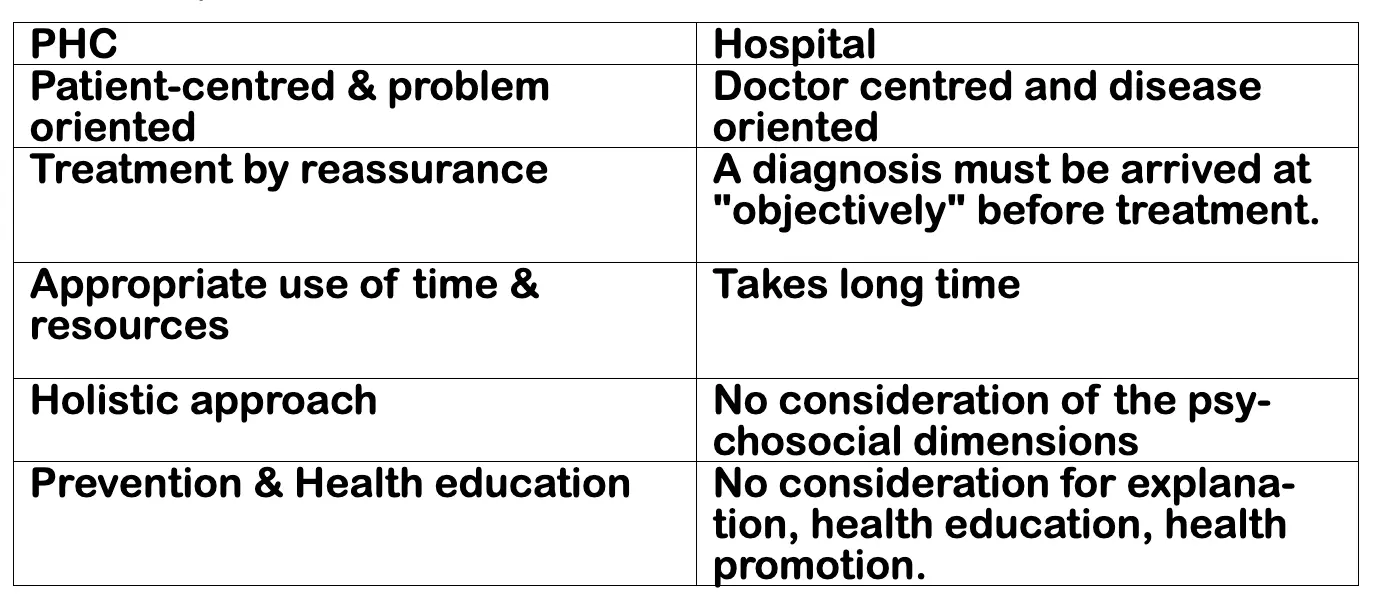
Differences Between Consultation in PHC & Hospital
- What are the differences between consultation in PHC & Hospital?
Modification of Help Seeking Behavior
- Define ‘Modification of Help Seeking Behavior’ - Give example.
- Modification of Help Seeking Behavior refers to changing the way individuals seek assistance or medical help, often to encourage more timely or appropriate use of healthcare services.
- Example: Educating patients about the importance of early intervention for chronic diseases to prevent complications.
Opportunistic Health Promotion
- What is Opportunistic Health Promotion – Give example.
- Opportunistic Health Promotion involves taking advantage of every interaction with patients to promote healthy behaviors and lifestyle changes.
- Example: A doctor advising a patient on smoking cessation during a visit for an unrelated issue.
Patient’s ICE
- What are the Patient’s ICE? – When to use in the consultation?
- ICE stands for Ideas, Concerns, and Expectations. It is used to understand the patient’s perspective and should be explored during consultations to ensure patient-centered care.
Safetynetting
- Define (Safetynetting)? – Give examples
- Safetynetting involves providing patients with information on what to do if their condition does not improve, worsens, or if they have concerns after a consultation.
- Example: Advising a patient to return if symptoms persist or new symptoms develop.
Housekeeping
- Define (Housekeeping)? – Give example
- Housekeeping in a medical context refers to the organization and management of tasks to ensure a smooth and efficient consultation process.
- Example: Ensuring all patient records are updated and accessible before a consultation.
Enhancing Concordance
- How to Enhance Concordance?
- Enhancing concordance involves building a mutual agreement between the patient and healthcare provider on the treatment plan, ensuring that the patient’s preferences and values are considered.
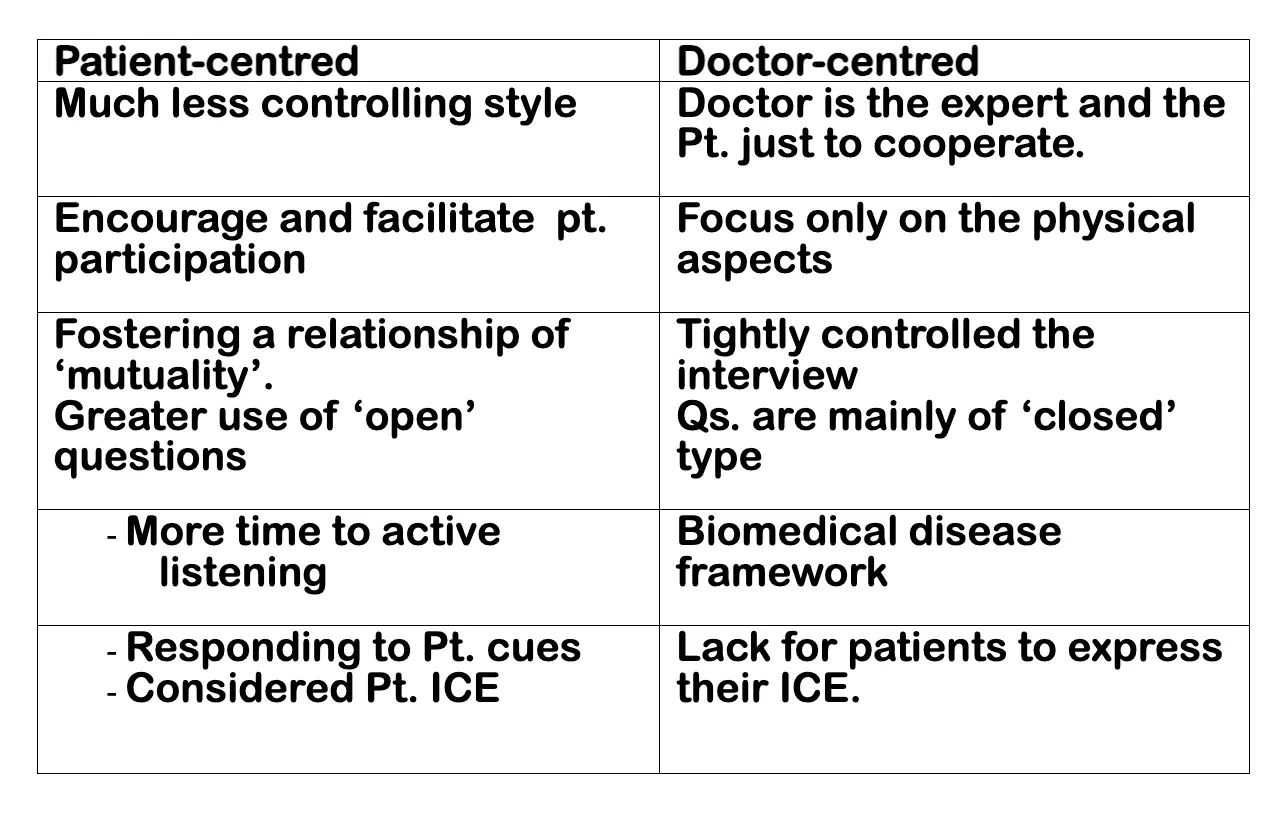
Differences Between Doctor-Centered and Patient-Centered
- Differences between Doctor-centred / Patient-centred?
- Doctor-centered care focuses on the physician’s perspective, often prioritizing clinical outcomes over patient preferences.
- Patient-centered care emphasizes understanding the patient’s needs, values, and preferences, and involves them in decision-making.
Core Values of Family Physicians
-
Mention the Core values of Family Physicians?
- Generalist
- Patient-oriented
- Gate-Keeper
- Patient Advocator & Continuity of care
Patient Signals or Cues
- What are the patient signals or cues? How to respond to patient’s cues?
- Patient signals or cues are verbal or non-verbal indications of their thoughts, feelings, or concerns. Responding involves acknowledging these cues and addressing them empathetically to ensure effective communication.
Dysfunctional Consultation
- What is the Dysfunctional consultation?
- A dysfunctional consultation is one that fails to meet the needs of the patient or healthcare provider, often resulting in poor outcomes or dissatisfaction.
- What are the reasons for Dysfunctional consultation?
- Reasons can include poor communication, lack of empathy, inadequate information gathering, and failure to address patient concerns.
- What are the signs for the Dysfunctional consultation?
- Poor reputation among patients
- Upset patients or doctors
- Increasing complaints
- Increasing critical events
- Reduced job satisfaction
Information Gathering (History Taking)
- What is the best skill for information gathering (History taking)?
- The best skill for information gathering is active listening, which involves fully concentrating, understanding, responding, and remembering what the patient says.