CHRONIC MYELOID LEUKEMIA (CML)
Dr Waqar
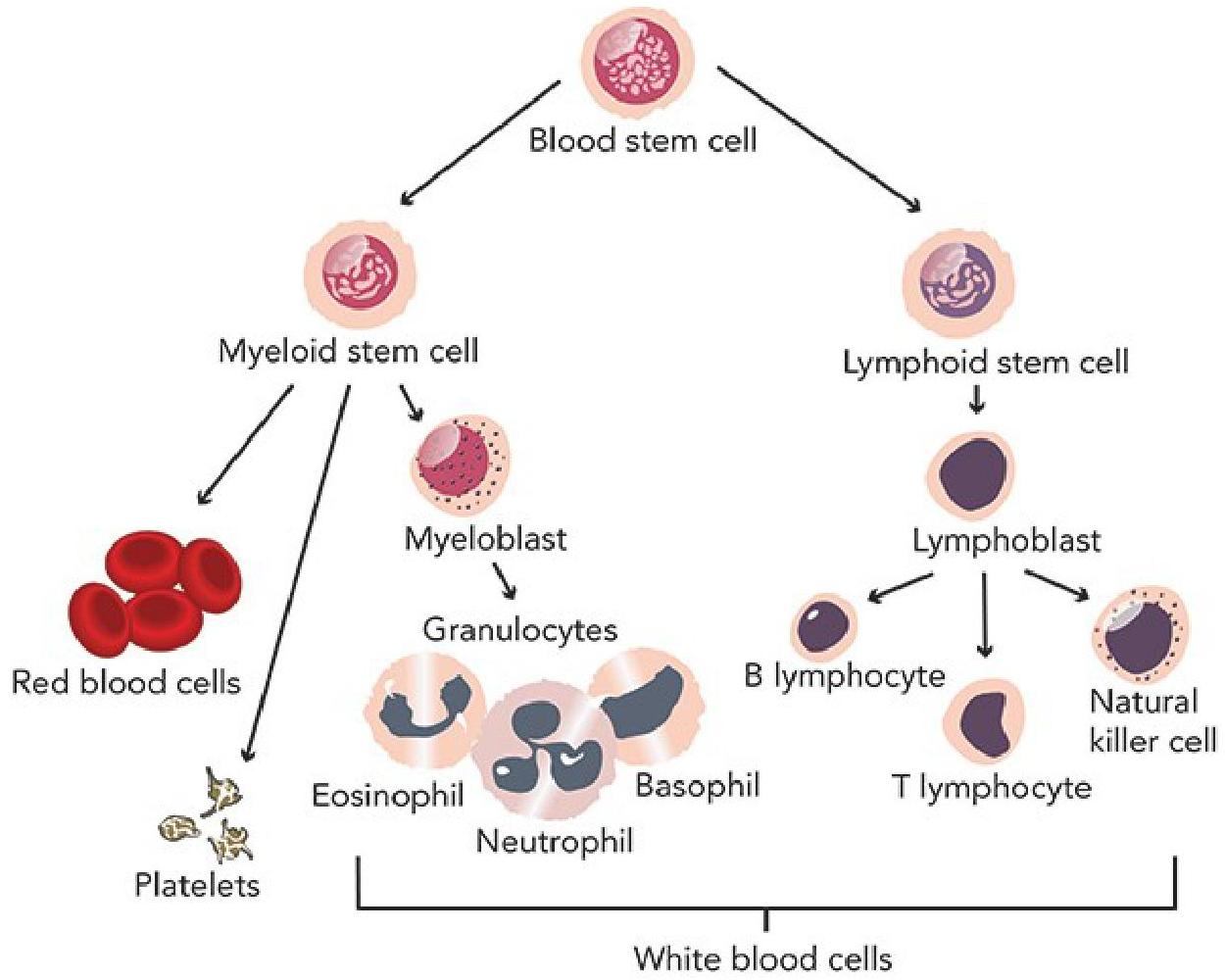
NORMAL WBC FORMATION
CML DEFINITION
- It is a malignancy of WBCs in which there is excess production of myeloid cells (neutros., basophils & eosinophils). The cells are mature looking but functionally abnormal.
REMEMBER: AML vs CML
AML is also a malignancy of myeloid cells but:
- It runs an acute course (rapid)
- The leukemic cells are immature looking “blasts” (myeloblasts) & the cell of origin is an earlier precursor of WBCs
(remember, blast cell is always an immature cell & seen in acute leukemias)
SOME GENERAL POINTS
- It has an insidious and gradual onset.
- Occurs in middle to old age (around 55)
- The cancer cells contain an abnormal chromosome called “Philadelphia chromosome” having the bcr/abl gene
- In most cases, it is curable
- The drug IMATINIB has revolutionized the treatment & prognosis
Ph chromosomes with bcr/abl gene
EPIDEMIOLOGY
- Age group: Middle to old age. Rare in children
- Gender: Slightly more in males
- Accounts for 8% of all leukemias in U.K.
PHASES OF CML
CML is classified into 3 phases, based on clinical features and lab findings:
| Phase | Characteristics |
|---|---|
| Chronic phase | Initial phase, slow-growing tumor |
| Accelerated phase | Faster cancer growth, rising WBC count |
| Blast crisis | Final phase, rapid progression, excess blast cells |
CHRONIC PHASE
- This is the initial phase & lasts for 3-4 yrs, if no treatment is given
- Tumour grows slowly & gradually
- Patients often asymptomatic initially & discovered on routine CBC (very high WBC)
- Later, maybe fatigue, weight loss, night sweats, huge spleen causing abdominal heaviness
- Fever, night sweats, recurrent infections
- If treatment is not given, this progresses into the next phase
ACCELERATED PHASE
- The cancer grows faster during this phase & WBC count rises fast
- There are specific W.H.O. criteria for diagnosis of accelerated phase (increased number of basophils & blast cells, spleen size, etc.)
BLAST CRISIS
- Final phase in the course of CML (if no treatment was given)
- Cancer progresses very rapidly and quick death occurs (behaves like acute leukemia)
- Excess “blast” cells can now be seen in the bone marrow & blood
- Patients present with fever, anemia, bleeding, & infections (more severe now)
TREATMENT IMPACT ON PROGRESSION
If treatment is given during the chronic phase, it may stop the tumor progression into the next phases
SIGNS AND SYMPTOMS (S/S)
Depend on the phase of the disease at the time of diagnosis:
- Asymptomatic
- Fatigue, weakness, wt. loss, fever, night sweats
- Splenomegaly ( often massive)
- Hepatomegaly, lymph node enlargement
- Features of anemia, bleeding & infections
DIAGNOSIS
1) Blood
- Very high WBC count (usually >150,000)
- High neutrophils, basophils & eosinophils (myeloid cells)
- Low hemoglobin (Hb), low platelets
2) Bone Marrow
- Hypercellular, with very high number of myeloid cells
BLOOD FILM
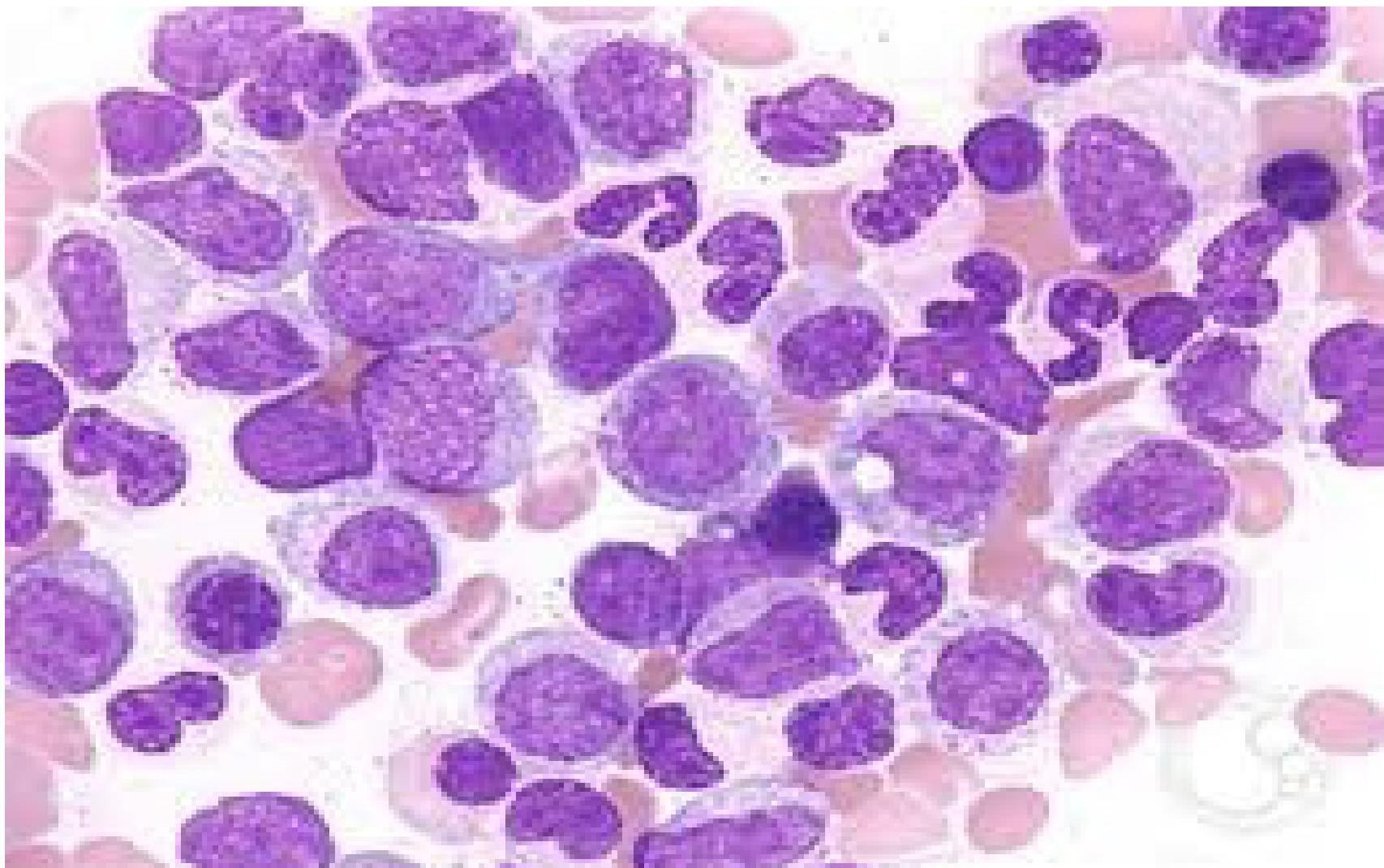
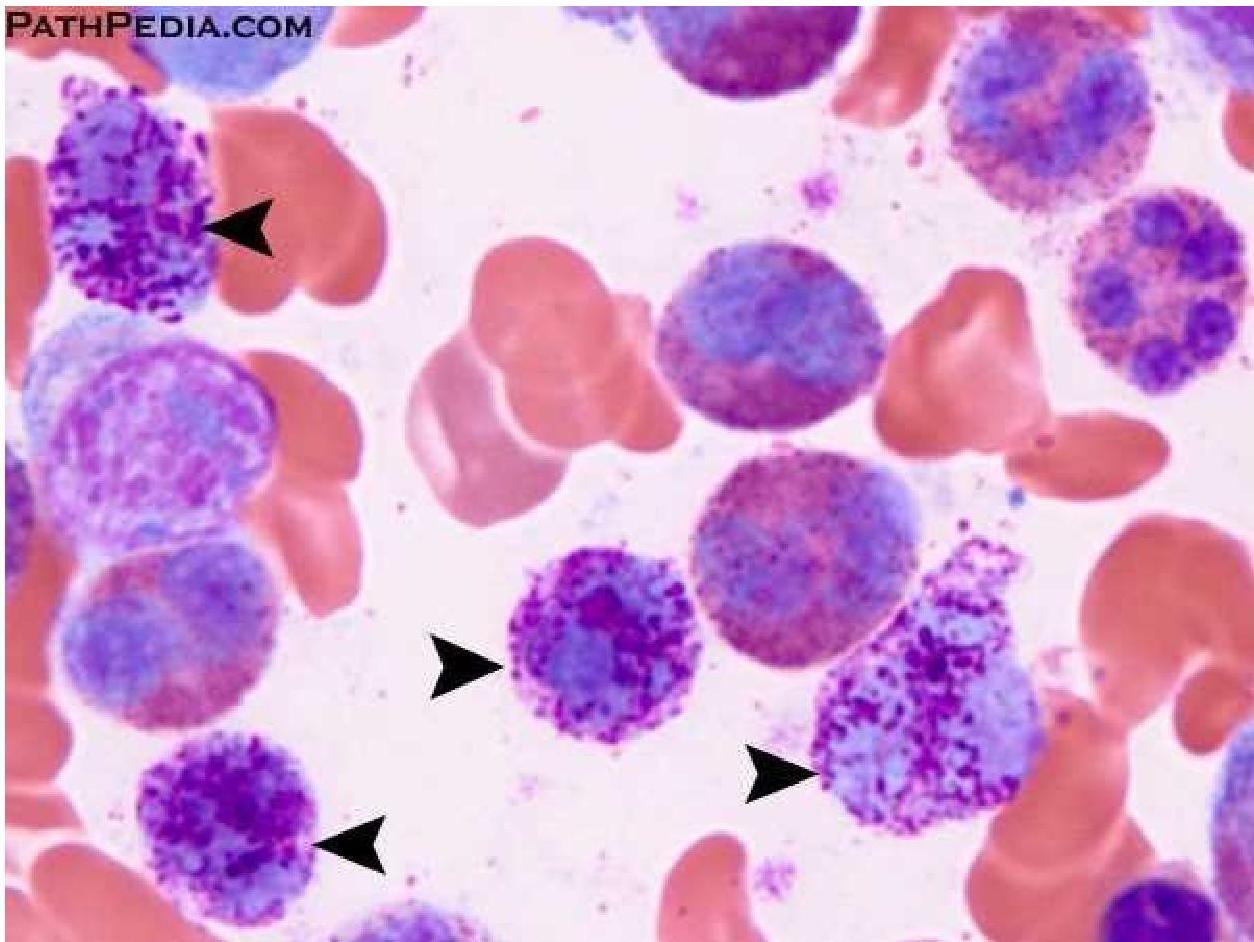
BONE MARROW
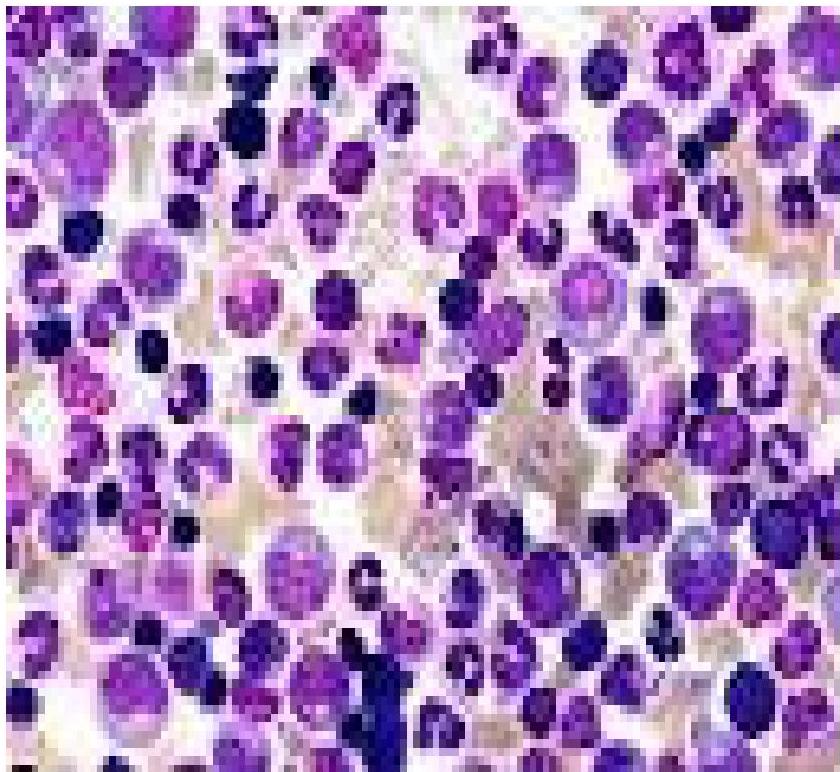
- Note the excess myeloid series cells
3) Cytogenetics (Gene Analysis)
- Leukemic cells have the Philadelphia chromosome (Ph chromosome) / bcr-abl gene
TREATMENT
1) Chronic Phase
- Imatinib (tyrosine kinase inhibitor)
- Introduced in 1999/2000. Very good survival rates with this drug (response in more than 95% of cases)
- Given for 2 years, can be repeated for a relapse
2) Accelerated & Blast Phase
- These phases are treated like acute leukemia (more aggressive treatment with other chemo drugs, plus imatinib)
PROGNOSIS
Greatly improved after “tyrosine kinase inhibitors”
Additional Treatment Options:
- Bone marrow transplant/ Stem cell transplant