Managing Increased Intracranial
Can occur due to any injury to brain
Pressure
Dr. Safdar H Malik
Leenah Turloman ♡
Introduction
- ? The cranium is a rigid compartment.
- ? Cranial Cavity contain:
- ? Contains the brain, vessels and cerebrospinal fluid.
- ? Can not expand after closure of the skull sutures.
- ? It’s ability to accommodate volume changes is limited.
10/18/2019
2
Cranial Contents
TABLE 19.1 Intracranial Contents and Their Respective Volumes
| Component | Volume | Percentage of Total Volume |
|---|---|---|
| Brain (70%) and interstitial fluid (10%) | 1400 mL | 80% |
| Blood | 150 mL | 10% |
| Cerebrospinal fluid | 150 mL | 10% |
| TOTAL | 1700 mL | 100% |
10/18/2019
3
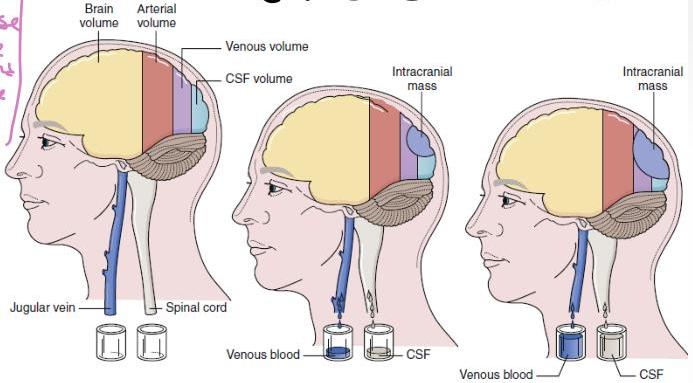
So anything that happens in the cavity these 3 Start to be displaced and Patient become symptomatic
Monroe-Kellie Doctrine
10/18/2019
4
Presentation
? Headache. → early morning → when patient lying straight, ICP level inc. but once patient start walking around, headache gradually improve. & all around the head
? Visual Symptoms. → because optic disc is connected with CSF (it is covered with dura) so when ICP inc, it affects optic disc.
? Vomiting. → projectile → so there is blurring of vision or even blindness recurrent vomiting lead to fluid in body to dec → headache improve
? Altered level of consciousness.
? Papilledema → a sign not a symptom ↓ blurred vision
10/18/2019
5
Etiology
? Space occupying lesions.
? Trauma.
? Hydrocephalus.
? Meningitis.
? Bleeding → hematoma
? Idiopathic intracranial hypertension
→ upto 15 is normal. 20-25 its idiopathic
→ can happen in any patient (young, adult, old)
→ more in female and obese → reducing weight → symptoms will improve
10/18/2019
→ Treatment: dec weight, dec production of CSF. Place Shunt → Ventriculoperitoneal Shunt or lumboperitoneal Shunt
6
Some patients improve by two
Effect on Cerebral Perfusion
? Normal blood flow to the grey matter is 75 ml/100 gm/min, and 45 ml/100 gm/min. ? Ischemia ensues at 20 ml/100 gm/min. ? Irreversible damage at 10 ml/100gm/min. ? Cerebral Perfusion Pressure is the most significant measure of blood flow.
10/18/2019
7
Effect on Cerebral Perfusion
-
CPP: the effective blood pressure gradient across the brain.
-
Calculated as: CPP= MAP-ICP.
-
*CPP: cerebral perfusion pressure, MAP: mean arterial pressure, ICP: intracranial pressure.
-
Increased ICP decreases CPP, leading to ischemia.
10/18/2019
8
Cerebral Auto regulation
- The ability of the brain to maintain blood flow across a wide range of CPPs.
- Increases in CPP cause vasoconstriction and vice versa.
- CO₂ tension controls auto regulation.
- Hyperventilation leads to decreased CO₂ tension leading to vasoconstriction.
10/18/2019
9
Failure of Auto regulation
- ? Auto regulation is limited to CPPs ranging from 50-150 mmHg.
- ? Failure of auto regulation occurs when CPP exceeds 150 mmHg.
- ? Blood flow increases and leads to vasogenic edema.
- ? Hypotension may contribute to worsening of the process. (CPP=MAP-ICP).
10/18/2019
10
Monitoring ICP
- ICP is the most important indicator of morbidity and mortality.
- Indicated in patients presenting with head trauma and spontaneous subarachnoid hemorrhage, as well as a GCS score between 3-8 and abnormal CT scans.
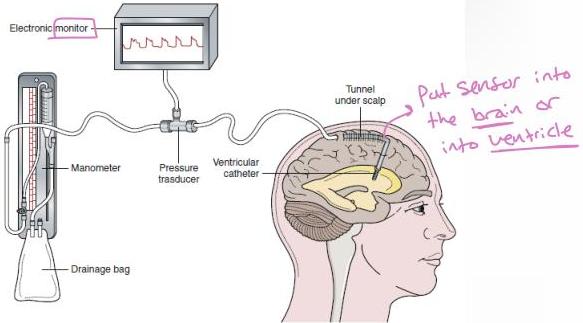
- Two main techniques of monitoring: intraventricular and intraparenchymal.
10/18/2019
11
Monitoring ICP
FIGURE 19.4 Intracranial pressure (ICP) monitoring system using ventricular catheter, pressure transducer, manometer, and drainage bag.
10/18/2019
12
Treatment
- Aims at decreasing ICP and optimizing perfusion to brain tissue.
- Utilizes auto regulatory mechanisms to achieve the required balance.
- Several targets of therapy lead to synergistic effect on ICP.
10/18/2019
13
Non-pharmacological
10/18/2019
14
Head Elevation
? Rapid, easy and effective. ? Keeping the head elevated at 30-45°. ? Uses the force of gravity to promote venous drainage. ? Head must be forward facing. ? Contraindicated in hypovolemic patients.
10/18/2019
15
Hyperventilation
- ? Leads to decreased blood flow to the brain by vasoconstriction.
- ? Rapidly decreases ICP.
- ? Target Pco₂: 30-35 mmHg.
- ? Sustained hyperventilation may lead to ischemia.
- ? Target: Cerebral blood volume.
10/18/2019
16
Hypothermia
→ decreasing body temp., the body metabolism also dec lead to dec ICP.
- ? Core temperature target of 32-35° for a few days.
- ? Controversial, but more centers are starting to embrace it.
- ? High incidence of manageable complications.
- ? Efficacious.
- ? Eurotherm3235 trial currently underway.
10/18/2019
17
Hyperbaric Oxygen
- Class I evidence suggests decreased mortality.
- Class IV evidence suggest acute decrease in ICP.
- Functional outcome controversial.
10/18/2019
18
Pharmacologic Management
10/18/2019
19
Sedation
- Intubation indicated when the patient is unable to protect airway or breath spontaneously.
- Propofol is the agent of choice due to short action and effect on brain metabolism.
Target: decreasing cerebral metabolism.
10/18/2019
20
Mannitol
? Osmotic agent most commonly used in high ICP.
? Effect is two-fold:
1- Creation of osmotic gradient which increases intravascular volume, leading to vasoconstriction.
2- Cumulative osmotic gradient causes interstitial fluid to enter vasculature leading to decreased edema.
10/18/2019
21
Mannitol
dose:
- Given in boluses of 0.25 g to 1 g/kg at 4 to 6-hour intervals.
- Most useful in the initial 48 to 72 hours.
- Monitoring of kidney functions, urine osmolality and electrolytes needed.
10/18/2019
22
Hypertonic Saline Therapy
- Emerging as an effective alternative to mannitol.
- Similar efficacy and mechanism of action.
- May be used beyond 72 hours.
- Superior to mannitol in hypovolemia and hypotension.
10/18/2019
23
Hypertonic Saline Therapy
- Boluses of 30 ml of 23.4% hypertonic saline
- Infused over 15 minutes through a central line.
- Sustained use may lead to electrolyte imbalances.
10/18/2019
24
Barbiturate Coma
- Controversial.
- Drug of choice is Thiopental.
- Requires intensive monitoring of vitals signs.
- May lead to hypotension.
10/18/2019
25
Opioids
to dec activity of the body
- ? Conflicting evidence, mostly due to use along with other ICP lowering agents.
- ? Used alone, they are thought to increase ICP and CBF.
- ? Fentanyl most commonly used, with remifentanyl emerging as a substitute.
10/18/2019
26
Corticosteroids
- ? Evidence against use. Especially in HI
- ? May increase mortality.
- ? Some agents have shown promising results.
NOT for head injury
10/18/2019
27
Surgical Management
bif medical treatment fail
10/18/2019
28
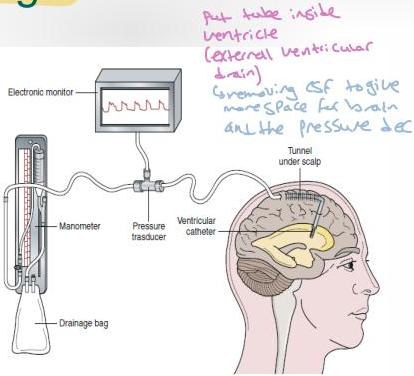
CSF Drainage
? Decreases CSF volume. ? Allows for ICP monitoring.
FIGURE 19.4 Intracranial pressure (ICP) monitoring system using ventricular catheter, pressure transducer, manometer, and drainage bag.
10/18/2019
29
→ last Choice
Decompressive Craniectomy
remove bone and open the dura giving the brain space to swell up
→ removing both frontal bones ? Bifrontal craniectomy or hemicraniectomy including the frontal temporal and parietal bones. ? Care side only defending on which side there is more swelling ? Cancels the Monroe-Kellie Doctrine and allows the brain to expand. ? Evacuation of an underlying hematoma if present. ? Remains controversial due to lack of class I evidence.
10/18/2019
30