Bullous Pemphigoid (BP)
-
Bullous pemphigoid affects elderly people, with onset usually after 60 years of age.
-
The blister in BP is subepidermal with an intact roof.
-
Has a benign course if compared to PV.
Pathogenesis
-
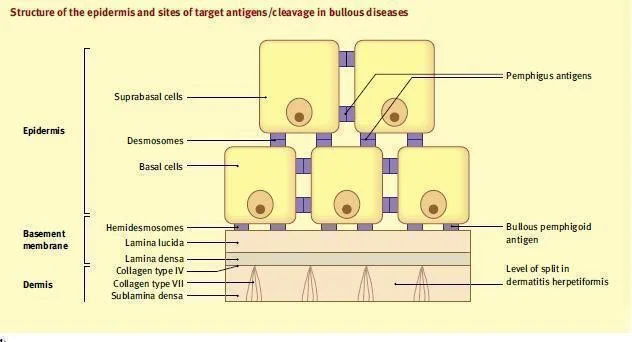
There is linear deposition of IgG & complement factors against proteins (Ags) at the dermo-epidermal junction.
-
The IgG antibodies bind to main antigens the BP Ag type 1 and BP Ag type 2 found in the hemidesmosomes in the lamina lucida.
-
Complement is then activated, starting an inflammatory cascade which results in separation of the lamina lucida.
-
Structure of the Epidermis and Target Antigens/Cleavage in Bullous Diseases
Clinical Features z
-
Pemphigoid is a chronic, usually itchy, blistering disease.
-
Early stage of the disease is characterized by pruritus.
-
Bullae may be centered on erythematous and urticated base.
-
-
Large tense bullae found anywhere on the skin
-
The flexures are often affected; inner aspect of the thigh, flexure surface of forearms, axilla, groin, and lower abdomen
-
The mucous membranes usually are not affected Z
-
The Nikolsky Asboe signs are negative Z
Bullous Pemphigoid
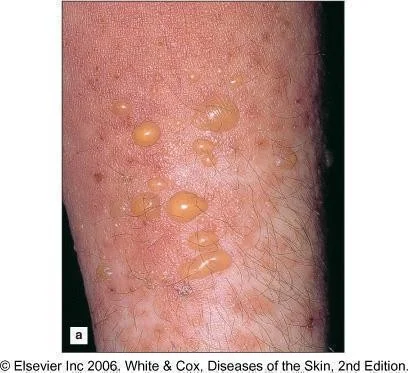
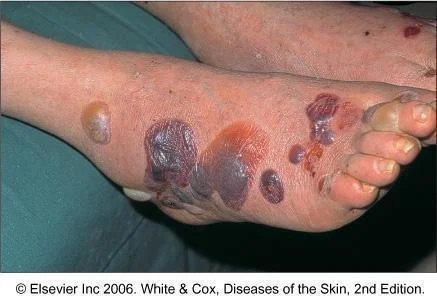
tense
Bullous Pemphigoid histology
![[Bullous Pemphigoid BP-1747636888441.webp|290x185]] ![[Bullous Pemphigoid BP-1747636904949.webp|290x215]] linear appearance
Prognosis
-
Untreated bullous pemphigoid runs a chronic, self-limiting course over a number of months or years.
-
The disease duration is usually 3-6 years, with most patients achieving complete remission off treatment.
Treatment
-
Topical and systemic steroids are the mainstay of treatment → For localized BP, very potent topical steroids are often sufficient
-
Low dose systemic steroid 30 to 40 mg/day
- Corticosteroid therapy has lowered morbidity from the disease considerably and most patients achieve remission off therapy