ER
- Definition: serum potassium > 5.5 mEq/L
- Causes:
- hemolysis/thrombocytosis/leukocytosis (lab artifact);
- cellular breakdown (rhabdomyolysis);
- impaired excretion (renal failure);
- transcellular shift (acidosis);
- hypoaldosteronism;
- medications (ACE inhibitors, potassium-sparing diuretics).
Clinical features
- Cardiac: ventricular fibrillation, AV blocks, asystole
- Neuromuscular: weakness, paresthesias, areflexia, ascending paralysis
- GI: nausea, vomiting, diarrhea
Evaluation
- ECG is essential in all hyperkalemic patients.
- If ECG changes present, start emergency treatment immediately.
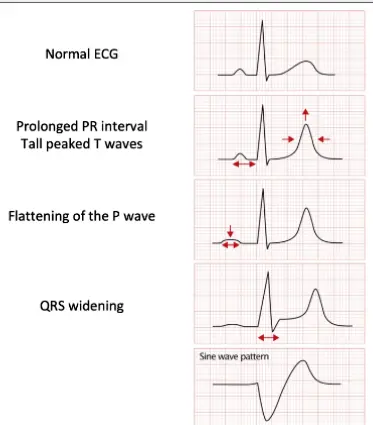
ECG changes
- Tall peaked T waves
- Flattening of the P wave
- Prolonged PR interval
- QRS widening
Treatment summary
| Mechanism | Therapy | Dose & Route | Notes |
|---|---|---|---|
| Cardiac membrane stabilization | Calcium chloride or calcium gluconate | 1 g IV (Ca gluconate) or 2 g IV (Ca chloride) | First medication if widened QRS |
| Shift potassium into cells | Regular insulin + dextrose | 10 units insulin IV + 100 mL 50% dextrose IV | Use 5 units IV insulin if renal dysfunction |
| Albuterol | 10–15 mg nebulized | ||
| Sodium bicarbonate | 50–100 mL IV | For severely acidotic patients | |
| Remove potassium from body | Furosemide | 40–80 mg IV | Ineffective in ESRD |
| Hemodialysis | Emergently in cardiac arrest, urgently in renal failure |
- Sodium polystyrene sulfonate (Kayexalate) is not effective for acute management and may cause GI necrosis/perforation.
Pediatrics
Causes
-
Potassium Shifts from the ICF to the ECF
- Metabolic acidosis
- Strenuous exercise
- Insulin deficiency
- Hyperglycemia
-
Medications
- Potassium-sparing diuretics (spironolactone)
- Potassium supplements (e.g., potassium chloride)
- ACE inhibitors
- Chemotherapeutic agents
-
Impaired Renal Potassium Excretion
- Renal failure
- Renal tubular acidosis (RTA)
- Adrenal insufficiency
- Congenital adrenal hyperplasia (CAH)
-
Movement of Potassium Out of Cells During or After Specimen Collection (Pseudohyperkalemia)
- Hemolysis
- Tumor lysis syndrome
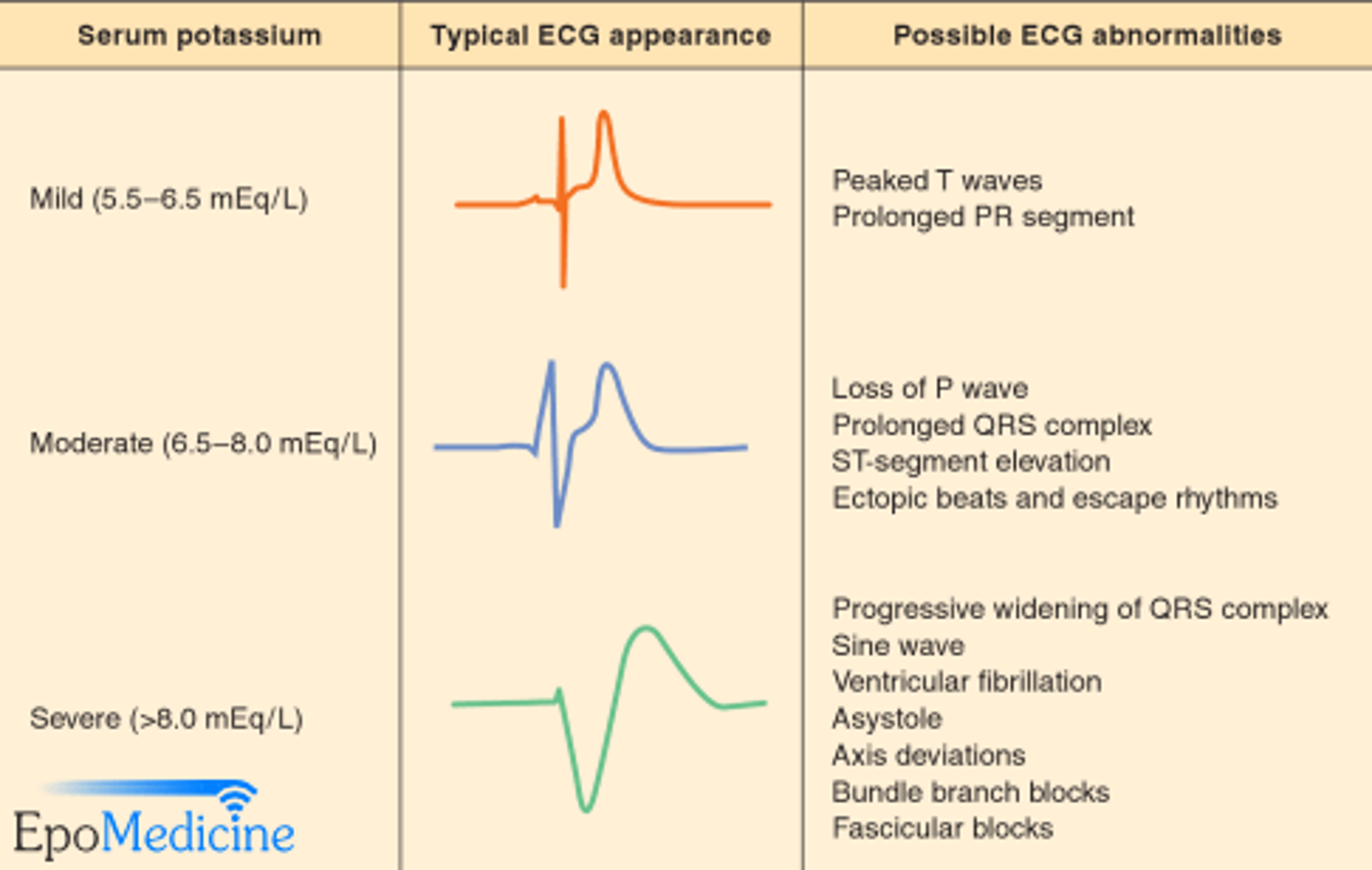
Hyperkalemia
- Serum K+ > 5.5 mEq/L
- Mild: S K+ = 5.5-6.5 mEq/L
- Moderate: S K+ = 6.5-8.00 mEq/L
- Severe: S K+ >8 mEq/L
Lab Tests
- Chemistry for other electrolytes
- Glucose level
- Urinalysis, urine potassium, and creatinine
- ECG
ECG Changes
- Prolonged PR interval
- Peaked T wave
- Wide QRS complex
- Absent P; flattening
- Asystole, VF
Clinical Features
- Muscle weakness, decreased deep tendon reflexes, ileus, tingling of the mouth and extremities, malaise, and tetany.
Hyperkalemia Treatment
First Line
- Salbutamol nebulization / ventolin: Shifts K into the cells. Effect appears within 20-30 minutes.
Second Line
- Insulin and Glucose /Dextrose infusion: Shifts K into cells. Effect appears within 10-20 minutes.
Third Line
- Furosemide: Excretes K through renal tubules. Effect appears within 60-120 minutes.
- Calcium Gluconate: Given in moderate to severe hyperkalemia to stabilize cardiac conduction. Z (ECG CHANGES GIVE IMMEDIATLY)
- Calcium Resonium (Kayexalate): Antagonizes K effect. Effect appears within 60-120 minutes. Z (PROTECT HEART AND ORGANS AGAINST K EFFECT)
Finally Excretion: Hemodialysis (Definitive).