Table of content
- Alopecia Areata
- Androgenetic Alopecia
- TELOGEN EFFLUVIUM
- Postpartum Effluvium
- Anagen effluvium
- TRICHTILLOMANIA
- Scaring Alopecia
Alopecia
Dr Sami Aldaham
Hair Biology
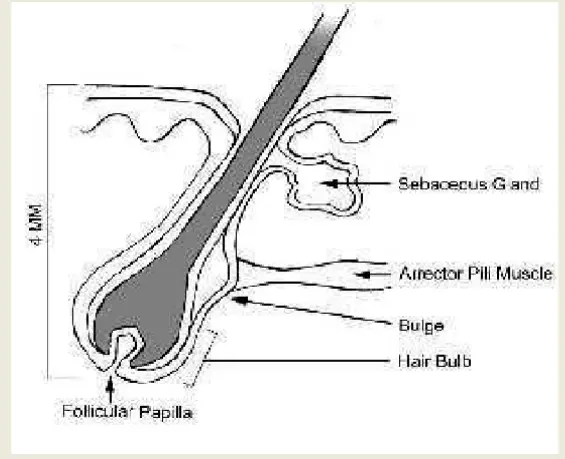
Hair Follicle Components (4 MM)
- Sebaceous Gland
- Arrector Pili Muscle
- Bulge
- Hair Bulb
- Follicular Papilla
Hair Follicle Components
Hair Types
-
Vellous: A. in the whole body B. bright in color C. thin, and short.
-
Terminal: A. Thick hair like the hair on the: B. scalp, eyebrow, axilla.
-
Androgen dependant terminal: In the androgen dependent areas as axilla, groin.
HAIR TYPES
Fetal hair -
- Lanugo hair : soft, fine, lightly pigmented hairs.
Adult hair -
- Vellus hair : fine hairs cover most of the bodyof youngsters and adults.
- Terminal hair: long, coarse, pigmented hairs with larger diameters.
NUMBER OF HAIRS
Scalp : about 1,00,000 hairs. Face : about 600 hairs /cm². Rest of the body : about 60 hairs/cm².
LENGTH, WIDTH AND GROWTH RATE
Length : range from <1mm to > 1 meter. Average uncut scalp hair : 25 – 100 cm.
Width : from 0.005 to 0.06mm. Growth rate: about 1 cm/ month (terminal hair).
FUNCTIONS
- Protects body surface from external injury.
- Helps in sensory function.
3. Psycho – social importance.
4. Forensic importance.
- i. Identification of race, sex, age and religion.
- ii. Cause of death- can be determined.
- iii. Time of death- can be determined.
- Assist thermo- regulation: mainly in lower animals.
HAIR CYCLE
It is believed that each hair follicle goes through 10-20 hair cycle in a life time. There are four phases-
- Anagen : growing phase.
- Catagen: involuting phase. transition into quiescence
- Telogen : resting phase.
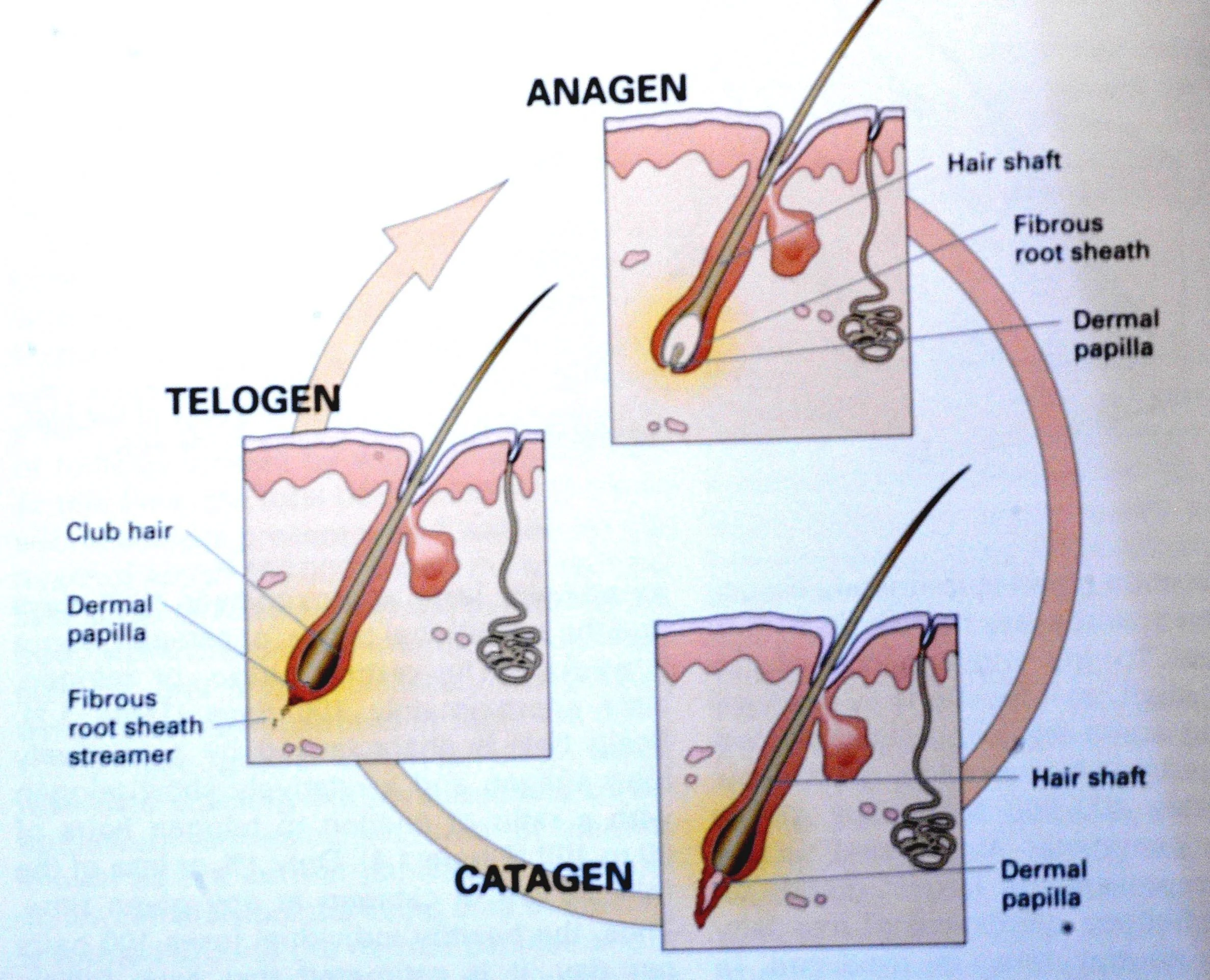
The hair cycle is divided into 3 stages:
- Anagen (growth phase):
- 70-80% of the hair follicle is in this phase.
- The length of this phase determines the length of the hair.
- The average is 3 years in the scalp
- Catagen (resting phase)
- 5% of the hair is present in this phase (the least).
- It last for 3 weeks
- Telogen (shedding phase):
- 15% of the hair is in this phase
- shortening of the hair & the epidermal papillea atrophies.
- And then the hair starts to grow in the Anagen phase.
- It last for 3 months and normally the person loss 150 hair a day
- So any disturbance in this cycle will result in the hair disease
ANAGEN (GROWING PHASE)
➤Last for about 1000 days. ➤Follicular cells grow, divide and become keratinized to form growing phase. ➤A darkly pigmented portion is evident just above the hair bulb.
CATAGEN
- Lasts for about 10 days.
- Scalp hairs show a gradual thinning and decrease of the pigment.
- Melanocytes cease producing melanin.
TELOGEN
- Lasts for about 100 days.
- Club-shaped proximal end shed from the follicle during telogen or subsequent anagen.
- Growth of a new anagen hair leads to shedding of any remaining telogen hair.
- But new hair does not “push out” the hair from the previous cycle.
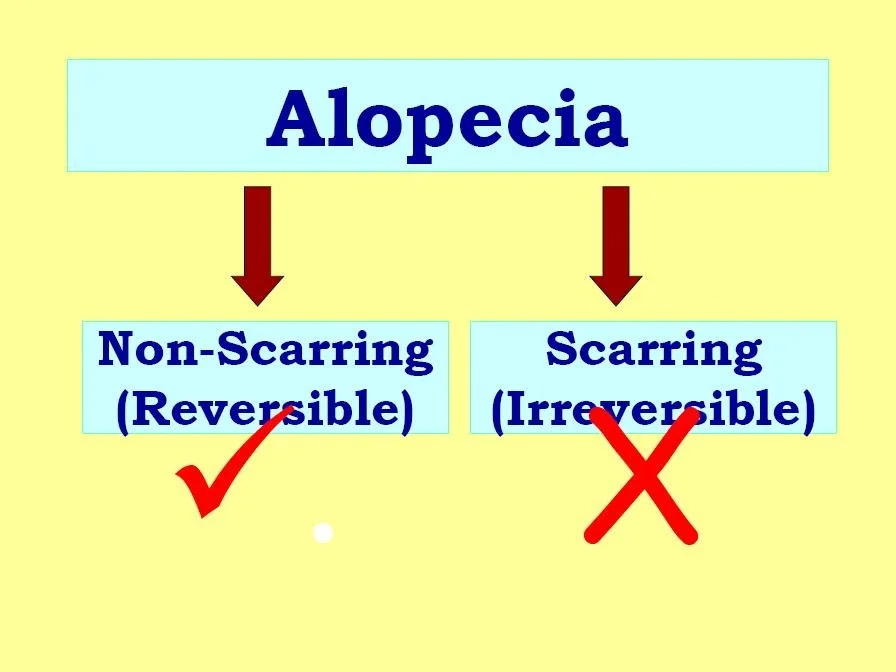
Scarring vs Non-Scarring Alopecia
Alopecia
- Non-Scarring (Reversible) - ✓
- Scarring (Irreversible) - ✗
Non-scarring vs Scarring Alopecia Explained
- Non-scarring alopecia (reversible):
- The skin is normal, so there is hope for the hair to grow again and it is treatable.
- It is called non-scarring because there is no fibrosis.
- In this type the hair follicles are Intact
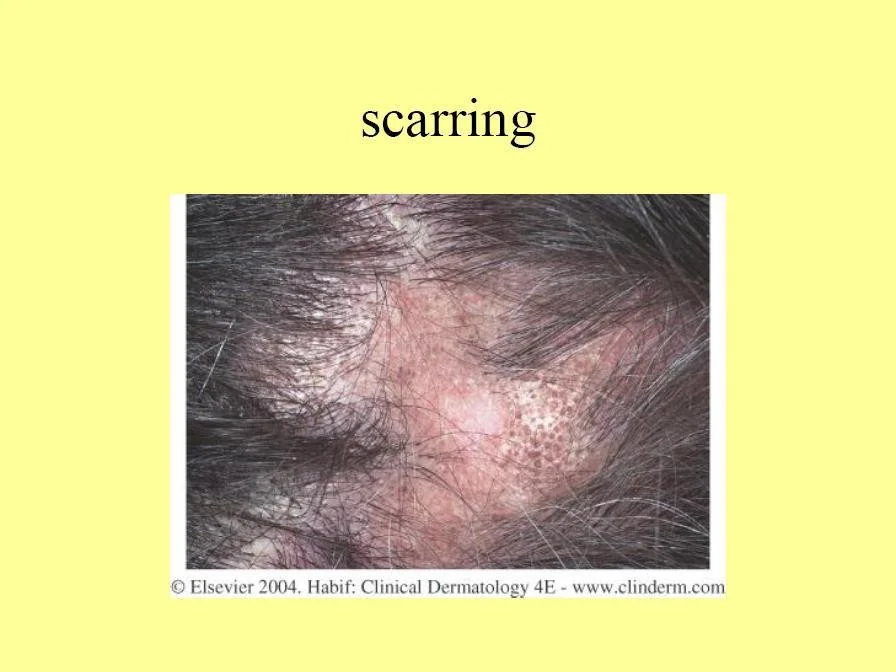
- Scarring alopecia (irreversible):
- There is fibrosis and severe inflammation,
- there is no hope for hair re-growth
- In this type the hair follicles are damaged
NB : How to differentiate between them clinically ? By looking for ( hair ostia ) by the scope→ if they intact then the alopecia is Non scaring and vise versa
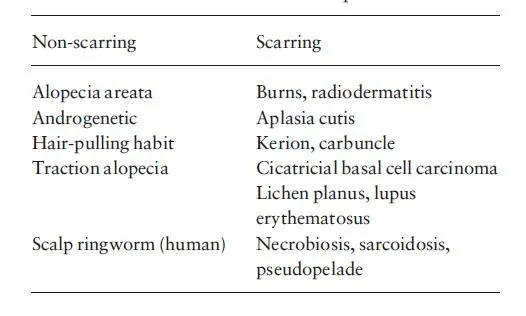
Causes of non-scarring alopecia
- Telogen effluviu : post- pregnancy, post-medication.
- Anagen effluvium: It occurs after chemotherapy.
- Alopecia Areata: Loss of hair in a well defined area
- Androgenetic alopecia: more in male.
- Hair shaft abnormality: Due to a genetic disease.
- Trauma: Some people when they are in stress they pull their hairs.
- Infectious disorder: e.g. Tinea pedis could be scarring or non- scarring ( more usually ). If there is inflammation, then there is scarring.
- Infections: Severe infections.
Causes of scarring alopecia
- Neoplastic disorders: Basal Cell Carcinoma.
- Trauma: 2nd & 3rd degree burns.
- Lichen planus: It’s a common cause of scarring hair loss.
- Discoid lupus erythematosus
Hair Excess
- Hirsutism
- Hypertrichosis