Collection from previous batches, made by Abdulmalik Abdulghani, Dania AbuObaid, Faisal Alkharji, Haneen H. Alsultan, Husna Merza, Lina Serhan, Maha Alasmari, Mujahid N Al-muhaydib, Yousef Edress
اللهم يا معلّم موسى علّمني، ويا مفهم سليمان فهّمني، ويا مؤتي لقمان الحكمة وفصل الخطاب آتني الحكمة وفصل الخطاب اللهم اجعل ألستنا عامرة بذكرك، وقلوبنا بخشيتك، وأسرارنا بطاعتك، إنك على كل شيء قدير، حسبنا الله ونعم الوكيل
Any updates of this file would be within https://medatlax.com/Clinical/Level-12/IM-2/Internal-Medicine-2 OSCE & OSPE-CS link.
https://www.youtube.com/playlist?list=PLHxXXvsPKjZk
Contents
Coverage review and corrections: IM2-OSCE-coverage-audit.
- Examinations: CNS · CVS · Respiratory · General · L.L. & cerebellar · Thyroid · Abdomen
- Histories: GI bleeding · Chest pain · Jaundice
Examinations
7. Neuro
Run sheet: WIPER · general (consciousness, orientation, neck stiffness, Kernig) → higher function → CN I–XII → motor (look, tone, power, reflexes, coordination) → sensory → gait → cerebellum. In the limb start with the normal side.
GCS
What is the score?
- Eyes — spontaneous 4 · to speech 3 · to pain 2 · none 1
- Verbal — orientated 5 · confused 4 · words 3 · sounds 2 · none 1
- Motor — obeys 6 · localises 5 · withdraws 4 · abnormal flexion 3 · extension 2 · none 1
- Record total and components (e.g. 9/15 = E3 V2 M4)
3–8 severe · 9–12 moderate · 13–15 mild.
Higher function
- Orientation: name, age, address, place, time/day/date/month (acute = delirium, chronic = dementia)
- Handedness · MMSE (orientation, registration, attention, recall, language)
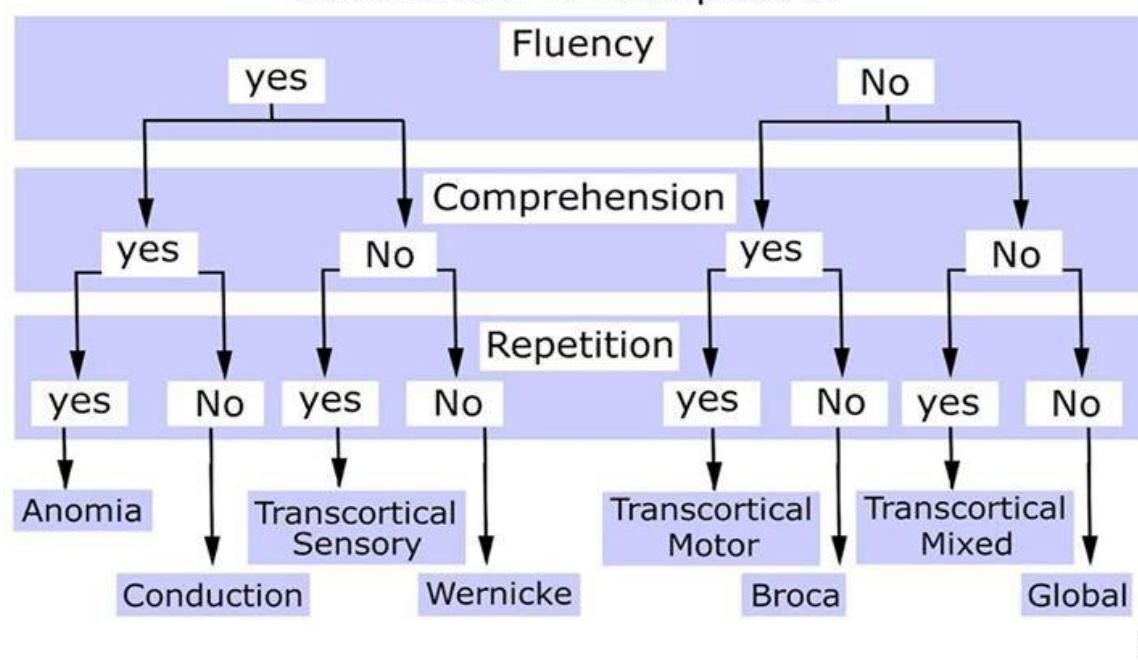
- Speech: free talk (room/job) · comprehension (commands) · repetition · naming (easy → rare) · reading · obey written command · writing (no motor deficit)
- Receptive (Wernicke): can’t understand, fluent but disorganised · Expressive (Broca): understands, non-fluent · Nominal: can’t name · Conductive: poor repetition, follows commands
- Dysarthria: articulation only (UMN cranial nerves, cerebellum) — palate/tongue (ر)/lips (ب) → “بغداد عاصمة جميلة”
- Dysphonia: voice quality (laryngeal, RLN). Cough test: normal cough = cords intact; dysphonia + normal cough = local/hysteria; bovine cough = cord palsy; fatigues = myasthenia
- Bulbar (LMN IX–XII) = nasal, flaccid, fasciculation · pseudobulbar (UMN) = hot-potato/spastic
- Memory: immediate · short-term (5 min) · long-term (>5 y) · Thinking: proverbs · Calculation: serial 7s
- Faces: famous faces → failure = prosopagnosia · Body perception: neglect = hemi-neglect; doesn’t recognise hand = asomatognosia
- Cortical sensation: astereognosis · graphesthesia · tactile localisation · two-point 3 cm
Lobes
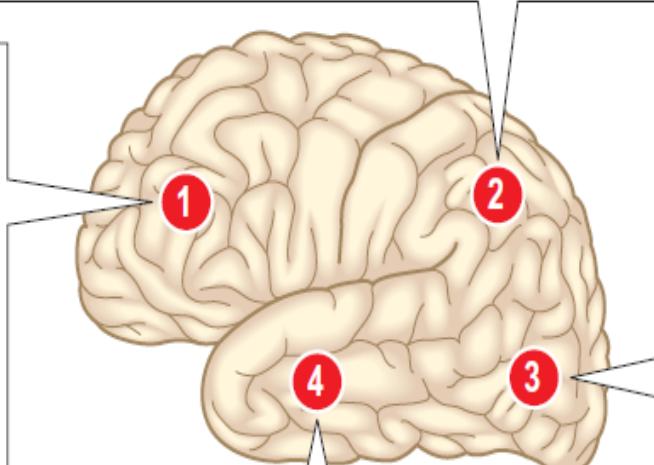
- Frontal — personality, emotion, social behaviour → disinhibition, apathy, antisocial, memory loss, incontinence, grasp reflex, anosmia
- Parietal (dominant) — calculation, language, planned movement, size/shape/texture → dyscalculia, dysphasia, dyslexia, apraxia, agnosia, hemianopia
- Parietal (non-dominant) — spatial, constructional → neglect, disorientation, constructional/dressing apraxia
- Occipital — vision → hemianopia, scotomas, visual agnosia, prosopagnosia, hallucinations
- Temporal (dominant) — hearing, language, verbal memory, smell → dysphasia, dyslexia, poor memory, hallucinations
- Temporal (non-dominant) — hearing, music, non-verbal memory, smell → poor non-verbal memory, lost musical skills
Meningeal irritation
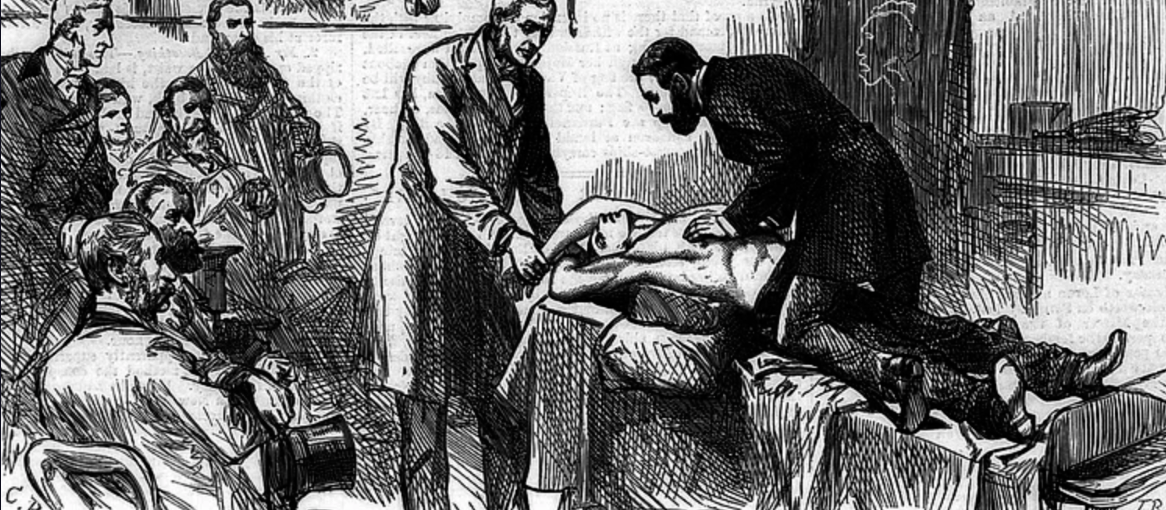
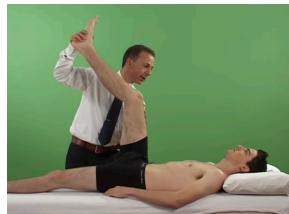
- Neck stiffness: active flexion, then passive · Kernig’s: flex hip, extend knee → pain/resistance · Brudzinski’s: flex neck → hips/knees flex + neck pain
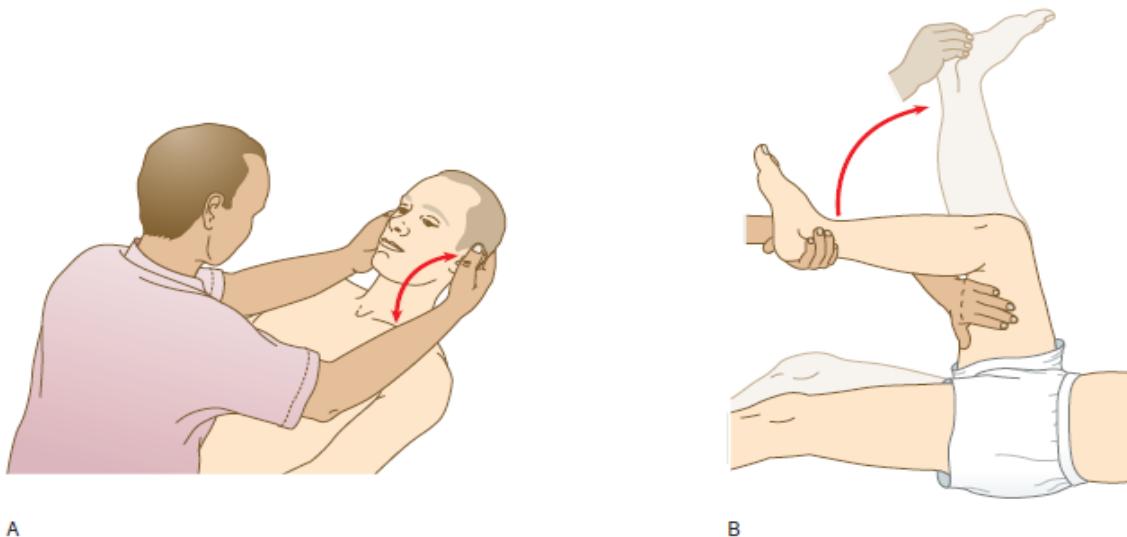
- Jolt test: head rotated ≥3/s → worsening headache (most sensitive for bacterial meningitis) · Kernig/Brudzinski positive in only ~half — absence doesn’t exclude
- Photophobia · headache worse lying down · LP only after CT + fundoscopy (exclude raised ICP/papilloedema)
Cranial nerves
Look first: facial asymmetry (nasal folds) · ptosis · squint · anisocoria · lip deviation to non-affected side + drooling · shoulder droop.
I — Olfactory: familiar odour each nostril (only if asked). Affected: infection, head trauma, frontal tumour, basal skull fracture; Kallman’s = congenital anosmia + hypogonadism (low FSH/LH).
II — Optic
- Acuity: ask about glasses/contacts, near (reading) + far (Snellen), each eye · if fails: count fingers → hand movement → light perception only (= blind)
- Colour: Ishihara — abnormal → congenital X-linked colour blindness, digoxin, ethambutol
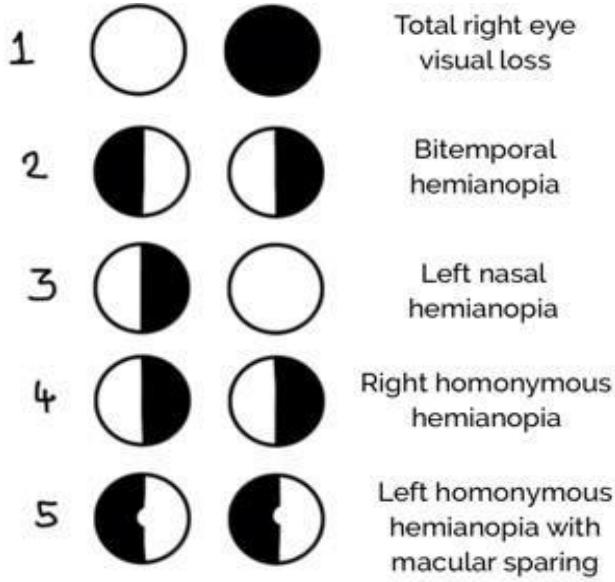
- Fields by confrontation: eye level, cover one eye each, 4 quadrants (“is it moving?“) → repeat · homonymous = tract/occipital · bitemporal = chiasm
- Pupils: direct + consensual (afferent II, efferent III) · accommodation far→near (30 cm) → convergence + constriction
- Marcus Gunn: swing torch pupil-to-pupil → abnormal pupil dilates paradoxically
- Fundoscopy: align your eye with pt’s right, left hand on their left shoulder, close your other eye; move in until yellow disc + vessels; papilloedema/retinal changes
- Affected: optic neuritis (MS), ischaemic optic neuropathy, pituitary compression
III, IV, VI
- Pupil size/shape/equality, ptosis · cover/uncover (squint: fix on your nose, cover then uncover → movement = squint)
- H pattern (6 fields) + X pattern (obliques); failure, diplopia, nystagmus · mnemonic: all oculomotor except SO4/LR6
- III down and out + ptosis + fixed dilated pupil (pupil involvement = surgical emergency, compressive aneurysm; pupil-sparing often diabetic/ischaemic) · IV can’t look down and in, vertical diplopia on stairs · VI can’t abduct, eye inward
- Causes: III PCA aneurysm, DM, brainstem stroke, trauma · IV head trauma, DM, brainstem · VI ↑ICP, DM, MS, basilar aneurysm
V — Trigeminal
- Sensory: cotton on sternum first, then V1 forehead, V2 cheek, V3 jaw, compare; repeat with pin
- Corneal reflex (afferent V, efferent VII) · Motor: clench → palpate masseter/temporalis · open mouth against resistance · jaw side to side (deviation = weak pterygoid)
- Jaw reflex: mouth slightly open, index on chin, tap down → exaggerated UMNL; absent V/VII damage
- Causes: UMNL corticobulbar · LMNL acoustic neuroma, MS, trauma · neuralgia
VII — Facial
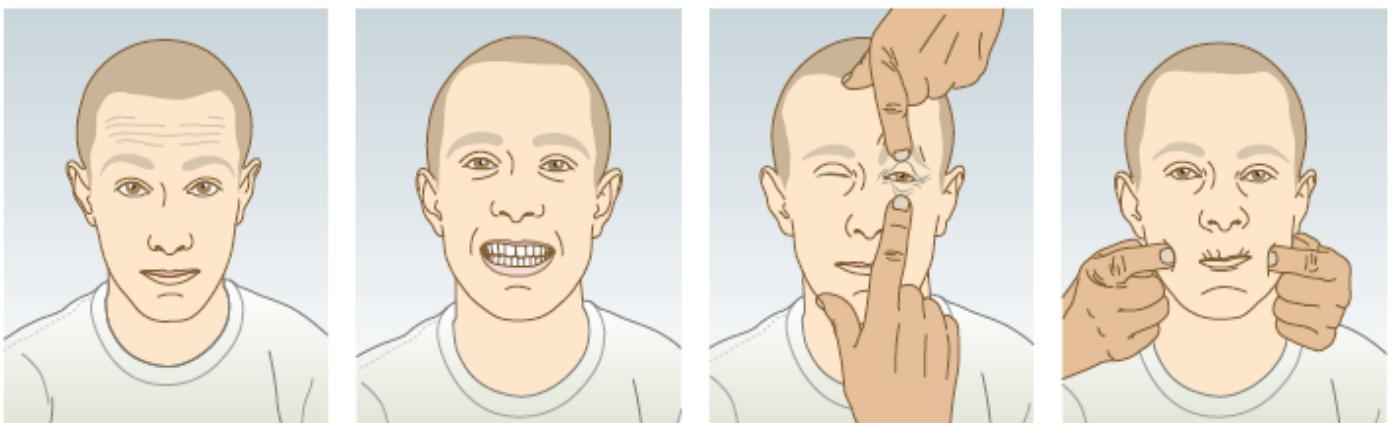
- Look: asymmetry, absent forehead wrinkles, smoothed nasolabial fold, lip deviation, drooling
- Motor: raise eyebrows · close eyes against your attempt · smile/show teeth · puff cheeks while you tap · whistle · clench teeth and watch platysma
- Taste anterior 2/3 (chorda tympani) · hyperacusis (stapedius) in LMN
- UMN (stroke) forehead spared; LMN (Bell’s) whole face; bilateral palsy may look symmetrical; also Ramsay Hunt, Lyme, parotid tumour · bilateral palsy → sarcoidosis, GBS, Lyme (not stroke/Bell’s)
VIII — Vestibulocochlear
- Whisper test · Rinne: mastoid then in front of ear — normal air > bone; conductive = bone > air (negative); sensorineural = same as normal (positive)
- Weber: mid-forehead — conductive lateralises affected ear; sensorineural unaffected
- Vestibular: arms out, eyes closed, march on the spot → drift/rotation = lesion
- Causes: sensorineural — acoustic neuroma, NF2, noise, aminoglycosides (gentamicin), Ménière’s, labyrinthitis, petrous fracture; conductive — wax/foreign body, otitis media, TM rupture, otosclerosis
IX & X
- Voice (hoarseness) · cough · sip of water (swallow) · “say ah” palate/uvula · gag + palatal reflex (mention)
- Causes: IX skull base tumour, neuralgia, jugular foramen · X UMNL (contralateral uvula deviation), LMNL tumour/trauma/endarterectomy
XI — Accessory
- Shrug against resistance (trapezius — ipsilateral drop) · head turn against hand (opposite SCM)
- Causes: UMNL stroke · LMNL trauma/surgery, tumour, compression
XII — Hypoglossal
- Inspect in mouth (size, wasting, fasciculation) · stick out (deviates to affected side) · push against tongue blade each side
- UMNL → contralateral deviation; LMNL → ipsilateral (neck trauma, medullary/skull base tumour, ALS)
Anatomy: III → SOF (PCA aneurysm); V → V1 SOF, V2 rotundum, V3 ovale; VII → IAM → stylomastoid; VIII → IAM.
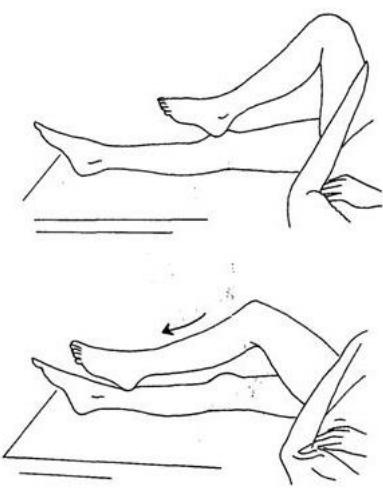
Coordination
- Finger-nose: intention tremor, past-pointing (use chin if tremor) · repeat stationary with eyes closed — error then = posterior column, not cerebellar
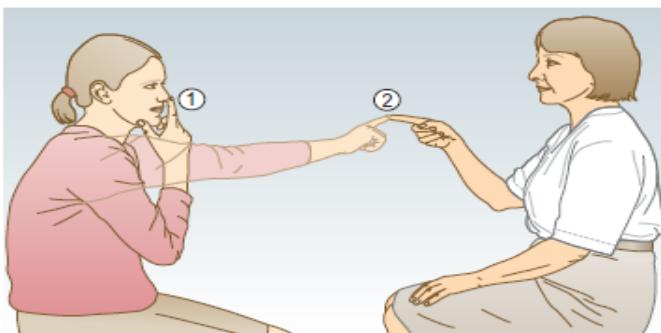
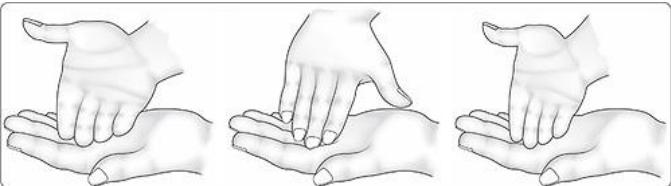
- Dysdiadochokinesia: rapid pronation/supination, then faster — speed, rhythm, smoothness · Nystagmus: follow finger, no head movement
- Rebound: flex against resistance, release → rebound/hypertonia = UMNL; violent flexion = cerebellar hypotonia
- Heel-shin: heel down opposite tibial border, then eyes closed — off-line = cerebellar/posterior column
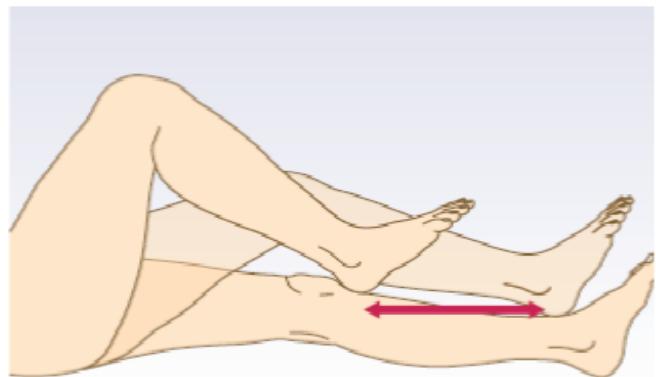
- Romberg: feet together, eyes open → close; positive in sensory ataxia, also cerebellar/vestibular
Motor
Look: wasting (denervation, myopathy, disuse) · fasciculations (at rest; tap and wait 30 s = LMNL) · position (hemiplegia, mask face, decerebration, decortication) · deformity (wrist/foot drop, claw hand) · tremor (rest Parkinson; postural/action essential, thyrotoxic, drugs, liver/renal, alcohol withdrawal; intention cerebellar; asterixis)
- Spine/back: deformity/scoliosis, scars, tenderness, hair tufts/skin tags; auscultate bruits; saddle sensation + anal reflex if sphincter symptoms · Adam’s forward flexion (rib hump = scoliosis)
Tone: big joints, relaxed, distal→proximal; normally slight resistance
- LL: leg roll + thigh-drop — lift heel and let it drop; flaccid = LMN, stiff = UMN; palpate bulk/tenderness
- Hypertonia (UMN): spasticity (worse with speed), clasp-knife; rigidity = lead-pipe, cogwheel (Parkinson) · Hypotonia: LMN, but also cerebellar disease and early cerebral/spinal shock (transient flaccid areflexia below a new cord lesion)
Power — MRC: 0 none · 1 flicker · 2 gravity-eliminated · 3 against gravity no resistance · 4 minimal resistance · 5 normal. ≥3 = against gravity.
- Shake hands at start (tone, tremor, asterixis, thenar bulk) · pronator drift (arms forward, palms up, eyes closed 10 s → drift/pronation = UMN)
- Arm drop test (deltoid/axillary): passively abduct 90°, release → drop · winged scapula (serratus/long thoracic): push wall, look at back
- Ulnar paradox: claw hand only in low ulnar lesions (high lesion paralyses ulnar ½ FDP → no claw); median → thenar wasting, ape hand, pointing index
| Upper limb | Root | Lower limb | Root |
|---|---|---|---|
| Shoulder abduction / adduction | C5,6 / C6,7,8 | Hip flex / ext / abd / add | L2,3 / L5,S1,2 / L4,5,S1 / L2,3,4 |
| Elbow flex / ext | C5,6 / C7,8 | Knee flex / ext | L5,S1 / L3,4 |
| Wrist flex / ext | C6,7 / C7,8 | Ankle plantar / dorsiflex | S1,2 / L4 |
| Finger flex/ext, abd/add | C7,8 / C8,T1 | Tarsal inversion/eversion | L5,S1 |
- EHL L5 · toe flexion S1 · quick: stand on toes (S1) · heels (L4,5) · squat/stand (L3,4)
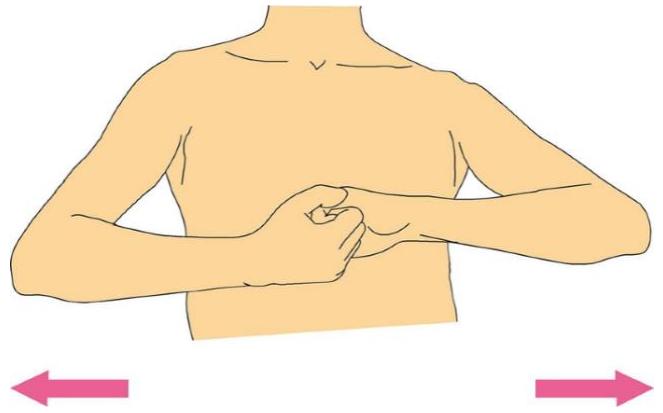
Reflexes 0 to +4. Reinforce: clench eyes / pull hands (Jendrassik) / clench teeth; poor ankle jerk → pre-dorsiflex foot; UL → move other wrist.
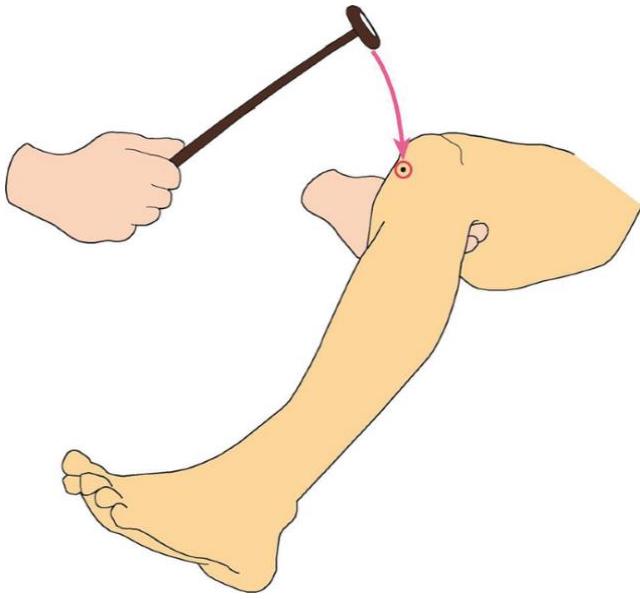
- Biceps C5,6 — elbow 120°, thumb on tendon, tap thumb · Triceps C7,8 — elbow 90°, tap tendon · Brachioradialis C5,6 — strike lower radius · Finger jerk C5
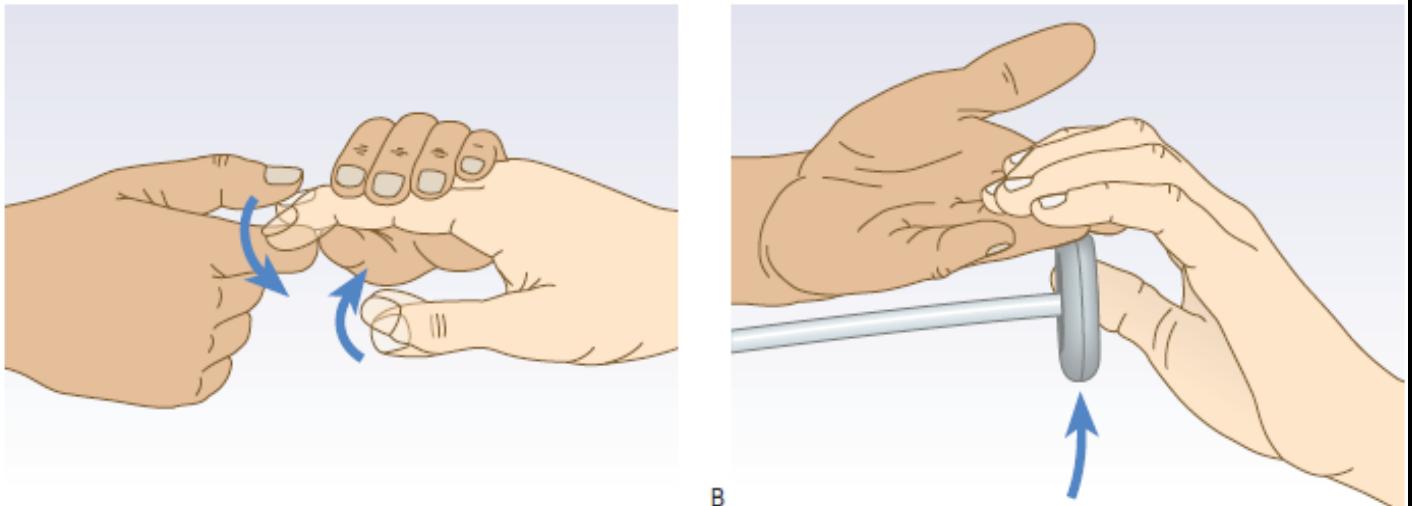
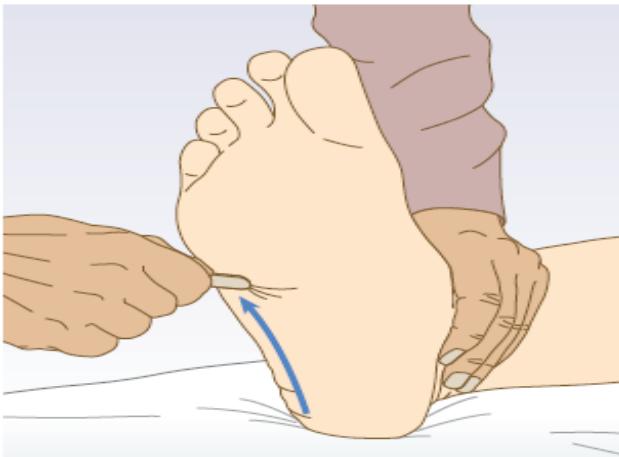
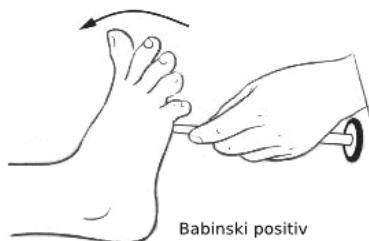
- Knee L3,4 — tap patellar ligament · Ankle S1,2 — knee+ankle 90°, tap Achilles · Plantar L5,S1,2 — stroke lateral sole with key, curve inward → plantarflexion normal
- Superficial: abdominal T6–T9/T9–T11/T11–L1 · cremasteric L1–L2 · anal S2–S4
- Babinski: upgoing big toe + fanning = UMN; also infants, after seizure, coma — say “extensor plantar response” · Hoffmann = UL Babinski (flick middle-finger tip, sitting)
- Spurling’s: cervical extension + rotation + axial compression → radicular arm pain
- Clonus (if hypertonia): sustain ankle dorsiflexion 5–10 s → oscillation; patellar clonus; demonstrate clasp-knife
UMNL vs LMNL — look: UMNL normal (late wasting), LMNL wasting/fasciculation · tone: UMNL ↑+clonus, LMNL normal/↓ · weakness: UMNL extensors arms/flexors legs, LMNL focal · reflexes: UMNL ↑, LMNL ↓/absent · plantar: UMNL extensor, LMNL flexor
Paresis partial · plegia complete · monoplegia one limb · hemiplegia one half · paraplegia legs · tetraplegia all four.

Sensory
- Pain (spinothalamic): needle, sharp vs dull · Temperature: hot/cold tubes (special cases)
- Light touch: cotton · Vibration (posterior column): tuning fork on bony prominence, when it stops — don’t go proximal until distal abnormal (lateral malleolus, distal phalanges)
- Proprioception: distal IP finger/toe, demonstrate, eyes closed, random
Dermatomes: C2 head · C3 neck · C4 shoulder · C5 lateral arm · C6 forearm/thumb · C7 middle finger · C8 medial forearm · T1 medial arm · T4 nipple · T10 umbilicus · L1 groin · L2 thigh · L3 medial knee · L4 medial calf · L5 big toe · S1 lateral foot · S3–5 perianal.
Light touch + vibration + proprioception = dorsal column · pain = spinothalamic.
Gait
- Walk ~10 m and back (power ≥3) · tiptoes (S1) · heels (L4,5) · tandem · Fog’s test (walk on outer edges → unmasks hemiparesis)
- Parkinsonian — stooped, shuffling, no arm swing, freezing → Parkinson’s
- Apraxia — small shuffling steps, hard to start, better cycling in bed → cerebrovascular, hydrocephalus
- Spastic paraparesis — stiff, scissors → cord
- Myopathic — waddling, Trendelenburg → dystrophy/myopathy · Gower’s sign (climbs up thighs = proximal myopathy)
- Antalgic — short stance painful side · Lurch — trunk shifts over stance leg (shortening/weak abductors) · Circumduction — stiff hip/spastic hemiplegic · High step — foot drop
- Central ataxia — wide-based, poor tandem → cerebellum · Sensory ataxia — wide-based, Romberg + → neuropathy/cord · Functional — bizarre, inconsistent
Stroke — exam
- UL flexed, LL extended (UMN pattern) · consciousness, orientation, speech · LL lateral rotation; wasting = old; fasciculations usually absent · tone flaccid early → hypertonic later · power hip flexion 0–5 · hyperreflexia + Babinski on affected side · gait asymmetry
DD: TIA · tumour/abscess · cerebral palsy · MS · Todd’s paralysis · hypoglycaemia.
Ix: non-contrast CT (blood white, infarct dark) · ECG (AF) · coagulation · glucose; then CT angio (LVO → thrombectomy), echo, carotid Doppler. Rx: ABC · tPA within 4.5 h (no recent surgery/bleeding) · outside window → anticoagulate if embolic · BP <185/110 before lysis, then judicious (penumbra) · haemorrhage → stop and reverse (vitamin K, FFP, PCC) · antiplatelet (if not AF) + statin · thrombectomy for LVO · risk factors + rehab.
Deficits by level
-
Brown-Séquard: ipsilateral dorsal-column loss + UMN signs, contralateral pain/temperature loss
-
Cerebellar/Romberg → cerebellar ataxia · Cord: thoracic → paraplegia, sphincter, sensory level; cervical → quadriplegia
-
Brainstem: crossed hemiplegia — IX–XII medulla · III,IV midbrain · VII,VIII pons
-
Cortical/subcortical: hemiplegia, monoplegia, slurred speech, convulsions · Spinal stroke: old → hypertonia (UMN); new → hypotonia (LMN)
-
Remember: ALS = UMNL + LMNL · Hoffmann = UL Babinski · acute paraplegia = demyelination, anterior spinal artery · intracranial causes = cavernous sinus thrombosis, parasagittal meningioma
4. CVS
Run sheet: WIPER · 45° · hands → CRT → palms → pulse → face → JVP → precordium (look/feel/percuss) → auscultate → lung bases → legs → abdomen.
Hands & pulse
- Clubbing · splinter · tar · Janeway/Osler · joint swelling
- Temperature both arms · capillary refill (CRT): press thumb 5 s → normal 2 s; <2 hyperdynamic; >2 poor perfusion
- Brachial pulse at antecubital fossa · full 6-point pulse (§2)
Face & neck
- Eyes: jaundice, pallor, periorbital oedema, xanthelasma; fundoscopy
- Cheeks: malar flush sparing nasolabial folds (SLE) vs generalised (PH/right HF)
- Mouth: angular stomatitis, caries, central cyanosis
- Musset’s sign (head bob — AR) · carotid: auscultate for bruit first, then palpate one at a time · JVD; measure JVP (§2)
Precordium — look
- Scars (CABG, pacemaker/ICD, drain) · rash/pigmentation · gynaecomastia (spironolactone, digoxin)
- End of bed: shape/symmetry on deep breath, deformity, pericardial plug, visible pulsation
Precordium — feel
- Palpate pacemaker/ICD if scar
- Apex: whole hand → one finger at most evident point → count from angle of Louis → 5th ICS midclavicular
- Not found? move palm right (shift/dextrocardia) → still not found → say so
- Impalpable causes: obesity, COPD/emphysema, effusion, dextrocardia, under a rib; lean forward/left lateral may reveal it; shifted to axilla = dilatation/MR
- Character: heaving = pressure load (LVH/AS/HTN) · hyperdynamic/thrusting = volume load (MR/AR) · tapping = MS (palpable S1)
- Thrills at 4 areas · palpable S2 = pulmonary HTN · parasternal heave (ulnar side) = RVH · JVP high → palpate liver
Percuss (limited)
- Dullness → pericardial effusion/tamponade or cardiomegaly; not routine
Auscultate
- Finger on radial to time systole/diastole
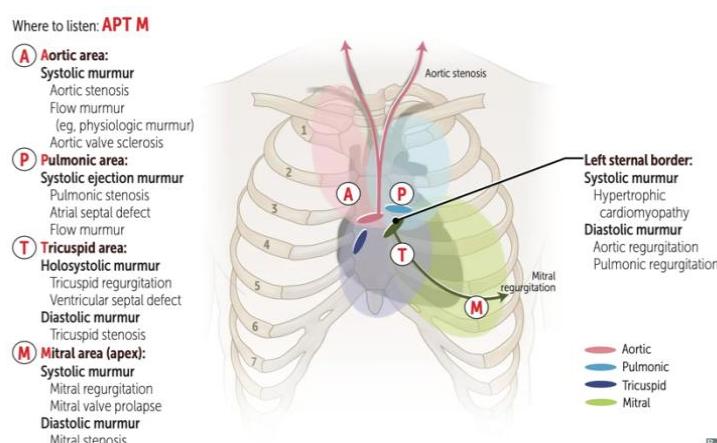
- S1 mitral: apex — bell (light) then diaphragm (firm); tricuspid: left 4th ICS · opening snap = pliable valve (favours valvotomy) · Austin Flint = apical mid-diastolic in severe AR
- S2 pulmonary: left 2nd ICS; aortic: right 2nd ICS + left 3rd (AR) · Erb’s point = left 3rd ICS
- Pericardial rub: superficial, scratchy, triphasic, ↑ sitting forward/pressure, persists on breath-hold
- Murmur: radiation — AS carotids · PS back · MR axilla · TR xiphoid
- Respiratory phase: right-sided (TR/PS) ↑ inspiration; left-sided (MR/AS) ↑ expiration
- Name valve → lesion → timing: ejection systolic (AS/PS) · early diastolic (AR/PR) · pansystolic (MR/TR) · mid-diastolic (MS/TS) · continuous machinery (PDA/AV fistula)
- Grade 1–6: 1 barely audible · 4 + thrill · 6 audible off chest
- S2: loud P2 = PH · soft P2 = PS · wide fixed split = ASD
- Left lateral → MS · sit forward → AR · listen opposite side (dextrocardia)
- Sit up → posterior lung bases (fine crackles) · inspect back · legs: oedema, sacral · abdomen: liver, ascites, AAA bruit
- Mention: ECG, echo, CXR, bloods → Close
Findings → interpretation
- Displaced hyperdynamic apex → volume load (MR/AR) · heaving → pressure load (AS/HTN) · tapping → MS
- Collapsing pulse + early diastolic + wide pulse pressure → AR · pansystolic to axilla + S3 → MR · mid-diastolic rumble + loud S1 + malar flush → MS · palpable S2/loud P2 + heave → PH/RVH
- Pulsus paradoxus → tamponade, PE, asthma, COPD, constriction · bisferiens → AR ± AS, HOCM, digoxin toxicity
- Pulsatile liver = TR (with tender hepatomegaly/ascites = right HF) · Kussmaul’s sign (paradoxical ↑JVP on inspiration) = constriction/right HF
- Marfan/EDS: arachnodactyly, elastic skin, pectus, tall → AR/dissection
Valve disease — AS vs MR
- Murmur: AS harsh ejection systolic RUSB → carotids · MR pansystolic apex → axilla
- Pulse: AS parvus et tardus · MR —
- Other: AS narrow pulse pressure, S4, HF late · MR displaced apex, S3, AF common
- Ask: AS exertional syncope, weak/delayed pulse · MR palpitations, weight gain, swelling
- Ix: AS echo (area, gradient, LVH), ECG, CXR, catheter, stress · MR echo (regurgitant volume, LV), ECG (AF), CXR
- Rx: AS medical role limited, AVR, TAVI if high risk · MR diuretics, vasodilators, rate control, repair/replacement, MitraClip
IE — what to hunt
Fever · new/changed murmur · Janeway (painless, palms/soles) · Osler (painful, fingertips) · splinter haemorrhages · Roth spots · emboli (stroke, renal/splenic infarct) · clubbing.
Duke: major = typical/persistent cultures + echo evidence (vegetation, abscess, new regurgitation). Minor = predisposing heart disease/IVDU · fever ≥38 · vascular phenomena · immunological (Osler, Roth, GN, RF) · cultures not meeting major. 2 major / 1 major + 3 minor / 5 minor.
5. Respiratory
Run sheet: WIPER · sitting, chest exposed (or 45°) · look (general → chest) → trachea → expansion → fremitus → percuss → auscultate → legs. Unilateral disease: examine lying on the affected side.
Look — general
- Speech/distress, O₂ litres, temperature · cyanosis/plethora · clubbing (bronchiectasis, cancer, fibrosis, ILD, empyema, abscess) · tar
- Thenar/hypothenar wasting (T1/Pancoast) · tachycardia/β-agonist overuse; AF = lung-cancer sign · breathing pattern (tachypnoea, Kussmaul, Cheyne-Stokes, bradypnoea <12) · RR 12–20 (count holding pulse)
- Cheyne-Stokes: HF, cerebrovascular, head injury, CO poisoning; normal in sleep/high altitude
Look — chest
- Symmetry on deep breath (unilateral ↓ = effusion) · accessory muscles · nasal flaring · barrel chest · pectus excavatum/carinatum
- Scars (thoracotomy, drains, cautery, radiotherapy marks) · kyphoscoliosis (restrictive) · movement incl. lower costal margins
- Face/neck: Horner’s (ptosis, miosis, anhidrosis → Pancoast) · SVC obstruction (plethora, injected eyes, chest-wall veins) · goitre (tracheal obstruction) · polyps · central cyanosis · JVD · cervical nodes (sit forward, from behind)
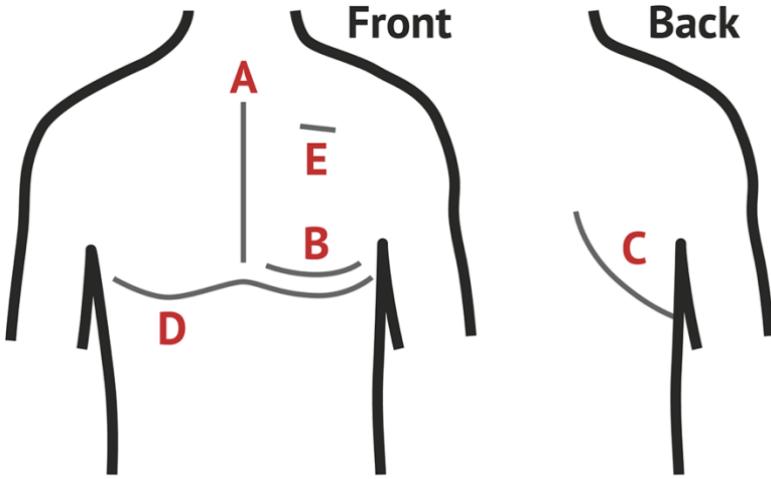
Chest scars: A sternotomy (CABG) · B anterior thoracotomy (lung biopsy, pericardium) · C posterolateral (most thoracic) · D clamshell (transplant) · E left subclavicular (pacemaker).
Feel
All anterior, then all posterior.
- Trachea: middle finger midline, index + ring on medial clavicles · tug (severe hyperinflation/COPD)
- Away = pneumothorax/massive effusion; toward = collapse
- Apex, parasternal heave, palpable S2
- Expansion 3 zones/side: anterior upper (above clavicles), lower (~6th ICS); posterior suprascapular, interscapular, lower (~10th ICS) · normal ≥5 cm
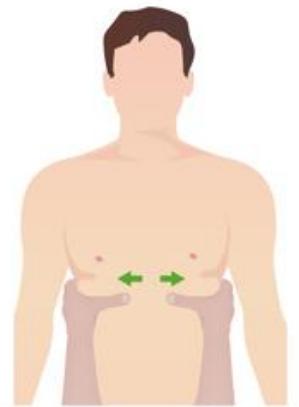
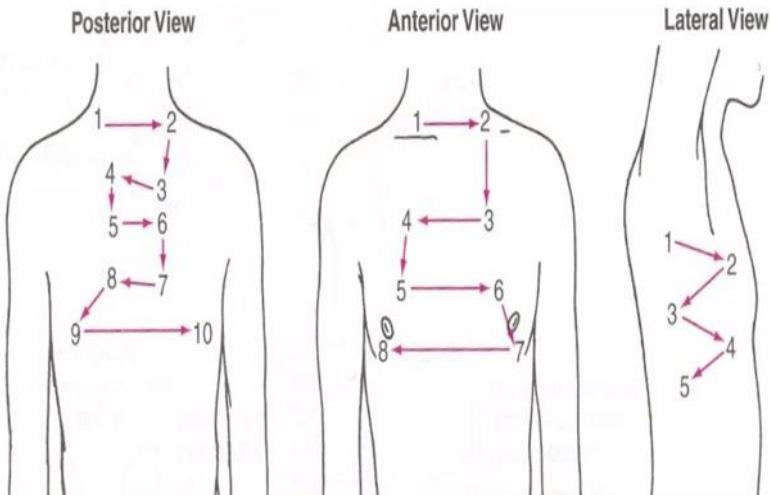
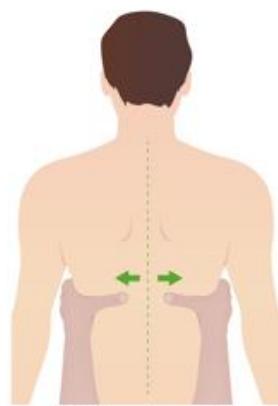
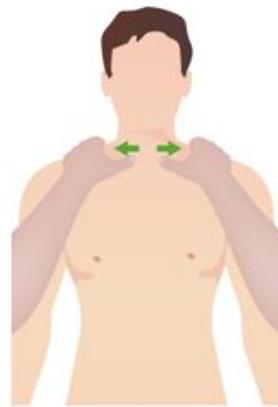
- Fremitus (“99 / أربعة وأربعين”): anterior upper lobes to 4th rib, below middle right/lower left; posterior hug self, to T4; ↑ consolidation, ↓ effusion/pneumothorax/obesity
Percuss
- Firm middle finger, two taps, lift fast; zig-zag, compare sides
- Positioning: hug self for scapulae, arms raised for axillae
- Anterior: supraclavicular apices · percuss clavicle directly (⅓ from sternum) · infraclavicular · chest wall ×3–4 · axilla
- Left 4th lateral (pericardium); right 4th/6th dull → deep breath + hold → still dull = consolidation, clears = liver
- Posterior: near vertebrae (avoid scapula), lateral below T4 · axillary line upper/middle/lower
- Notes: resonant · hyper-resonant (pneumothorax, emphysema) · tympanitic (cavity/pneumothorax) · dull (consolidation “woody”, effusion “stony”, mass)
- Loss of liver dullness (upper edge 6th rib MCL, resonance below) = hyperinflation · loss of cardiac dullness likewise
Auscultate
- First comment on air entry (reduced in collapse, effusion, pneumothorax)
- Vesicular: inspiration longer than expiration (~3 s), no gap
- Bronchial: hollow/high-pitched, louder/longer on expiration with a gap — normal over trachea, elsewhere = consolidation; silent chest = ominous
- Bronchovesicular: medium pitch, continuous through inspiration and expiration, below clavicles; peripherally = pathology
- Diminished normally in obesity/pregnancy; also obstructed airway, collapse, chronic lung disease
- Wheeze: expiratory = asthma/COPD; inspiratory = severe
- Stridor · pleural rub (pleuritis, painful inspiration)
- Crackles: coarse = bronchial consolidation; fine = fibrosis, late inspiration; also oedema, COPD, bronchiectasis
- Vocal resonance: bronchophony = consolidation · pectoriloquy = massive consolidation · egophony (E→A) = consolidation/upper level of effusion
- Legs: sacral oedema, ankle oedema, squeeze calves (DVT/PE), hepatomegaly (right HF)
- Say: hands, SpO₂, CXR + gases → Close
Findings → interpretation
- Dull + crackles + ↑ fremitus + ↑ vocal resonance → consolidation/pneumonia (also herpes labialis, nasal flaring, rusty sputum, fever 39–40)
- Hyper-resonant + ↓ breath sounds → pneumothorax
- Dull bases + ↓ fremitus + ↓ sounds (widened intercostal spaces; bronchial breathing above fluid) → pleural effusion
- Equal wheeze + ↓ fremitus + hyper-resonance + rhonchi → asthma
- Unequal wheeze + barrel chest → COPD
- Velcro basal crackles + clubbing → ILD/fibrosis
- Loud P2 + RV heave + ↑JVP → pulmonary HTN
2. General exam
Indications: renal, swelling, endocrine, malignancy.
Run sheet: WIPER · hands → pulse → face → neck (JVP, nodes, thyroid) → chest → abdomen → legs → CNS screen → vitals.
From the end of bed
- State of health: well vs ill; if ill acute (painful/respiratory distress) · chronic (>3 months: wasting, bony prominences, skin folds) · acute-on-chronic, with evidence
- Posture: comfortable · decorticate (arms flexed, fists clenched, legs extended) · decerebrate (head back, limbs extended, internally rotated) · localisation: decorticate = above red nucleus, decerebrate = below
- Striking: moon face (Cushing) · “wise old man” (malnutrition) · dysmorphism · hair · scars · limb-length
- Attachments: cannula (fluid), O₂ litres, catheter, drains (volume/colour), monitor, samples
Hands
- Clubbing — 3 checks: eye-level loss of hyponychial angle · Schamroth (no diamond) · fluctuation (spongy nail bed)
- CVS: cyanotic CHD, S.A, IE, LA myxoma · Resp: cancer, fibrosis, CF, bronchiectasis, empyema, abscess, ILD · GI: coeliac/tropical sprue, Whipple, IBD · liver: abscess, cholestatic disease, HCC
- Koilonychia (iron deficiency; Plummer-Vinson/Paterson-Kelly = koilonychia + IDA + dysphagia + splenomegaly) · onycholysis (fungus, psoriasis, trauma, thyroid) · splinter haemorrhage (liver, IE) · leukonychia (low albumin, CKD)
- Fingers: oedema, deformity, Janeway + Osler (IE), tar
- Palms: oedema · erythema (liver, MS, RA) · xanthomata · tremor (paper) · sweating
- Forearm: wasting, nodules, scars, bruises, AV grafts · arm temperature · shoulder droop
Pulse (6)
- Rate (15–30 s ×; 60 s if irregular) · rhythm · volume · character (alternans HF; paradoxus = tamponade/asthma/COPD/PE/constriction; collapsing = AR/PDA/AV fistula/anaemia/pregnancy/thyrotoxicosis/Paget — ask shoulder pain, radial + brachial, raise arm) · radio-radial delay · radio-femoral delay (coarctation)
- BP both arms: inter-arm >20 mmHg abnormal (dissection/subclavian); pulse pressure >100 → AR/dissection · coarctation: BP all four limbs; arm ≈20 mmHg higher than legs, weak/absent leg pulses
Face
- Upper lids, gaze down → jaundice; lower lids → pallor; subconjunctival haemorrhage (HTN, IE, coagulopathy)
- Periorbital oedema · ptosis · xanthelasma · mention fundoscopy
- Nose: polyps, discharge, flaring
- Mouth: angular stomatitis · pigmentation · open mouth, tongue out, lift → ulcer, central cyanosis, pallor, hydration · hygiene · gingival hyperplasia (phenytoin, cyclosporine, CCBs)
JVP
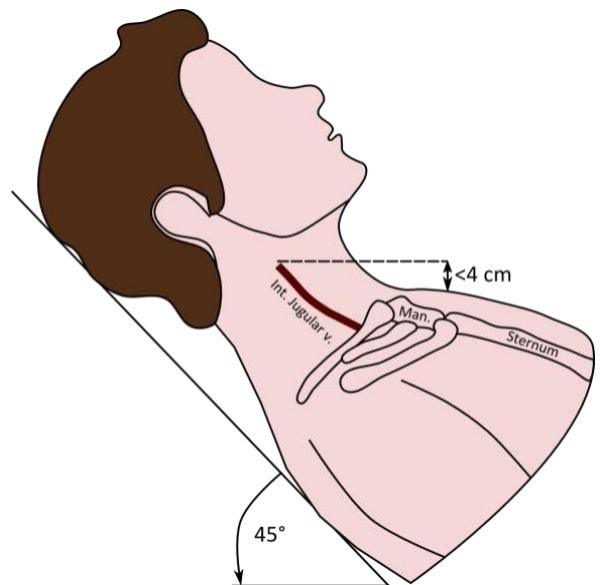
- Head left; if not visible lie 45° · right index at highest pulsation, other at sternal angle, measure +5 cm → normal 6–8 cm
- Two waves, reducible, ↓ inspiration · hepatojugular reflux (press RUQ 30–60 s → sustained rise >3 cm; falls on release) · a wave before carotid, v after · absent waves = SVC obstruction · carotid: one wave, palpable
Systemic features
- Pallor: mild conjunctiva/inner lip · moderate palms/creases/nail beds · severe skin/face/body
- Cyanosis: peripheral (extremities) vs central (lips, tongue, buccal); causes lungs/heart/blood; peripheral normal in babies if no central
- Jaundice: icteric/anicteric; pre-hepatic (haemolysis, malaria) · hepatic · post-hepatic
- Febrile state · mottling (hypoperfusion) · café-au-lait ≥5 >1.5 cm → neurofibromatosis · cranial bruit
- Clubbing stages: 1 spongy · 2 loss of Lovibond (Schamroth gone) · 3 convex nail fold · 4 drumstick · 5 hypertrophic osteoarthropathy
- Nodes significant if: cervical/axillary >1 cm · inguinal >1.5 cm · any supraclavicular (left = abdominal malignancy) · discharge/tenderness/redness; localised = one area, generalised = ≥2 non-contiguous
- Consistency: hard = malignancy · rubbery = lymphoma · soft tender = infection · matted = TB/metastatic
- Oedema: 1 ankle · 2 mid-shin · 3 knee · 4 above knee/sacral (pit 1+–4+ alternative)
- Hydration: mucosa · turgor (clavicle/back of hand) · tears in children
Lymph nodes
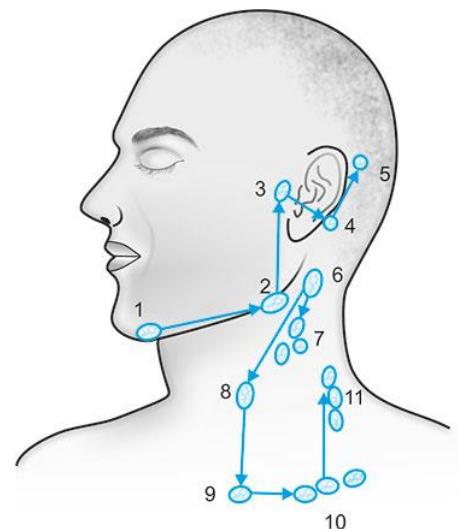
- Technique: pads of 2nd–4th fingers, press-and-roll, one side at a time (avoid carotid compression)
- Head/neck: preauricular · postauricular · occipital · tonsillar · submandibular · submental → turn head away: superficial cervical (along sternocleidomastoid) · posterior cervical · supraclavicular (shrug) · matted cervical = scrofula (TB)
- Axilla: pt holds your hand, abduct shoulder, flex elbow, arm on forearm — pectoral, posterior, central, lateral, apical
- Epitrochlear (3 cm above medial epicondyle) · inguinal (horizontal + vertical) · popliteal (knee 90°)
- Describe: size · tender · consistency · fixed/mobile · matted; nodule vs node: nodule moves with swallowing, fixed
Legs & finish
- Press 5 s over dorsum, medial malleolus, tibia, sacral (sit up)
- Causes: lymphatic obstruction/lymphoedema (non-pitting) · HF · cirrhosis · nephrotic; unilateral: cellulitis, lymphoedema
- Say you’d do: vitals, fundoscopy, all nodes, PR, urine dipstick, genitalia
- Close (summarise → problem list → dx → DD → Ix → Rx)
8. L.L. & cerebellar examination
Run sheet: WIPER · expose both limbs · end-of-bed impression · UL: drift → tone → power → reflexes → sensation → coordination; LL/cerebellar: gait first · A swelling → DVT, lymphoedema, cellulitis, trauma · B weak/wasted → neuro · C deformity → rheumatology.
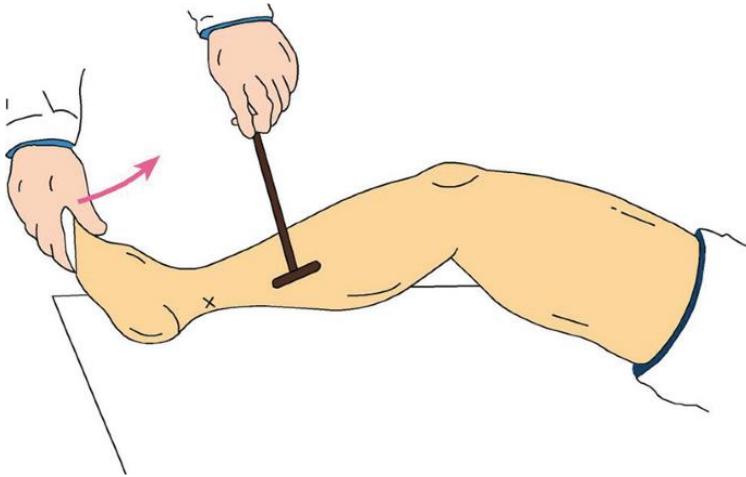
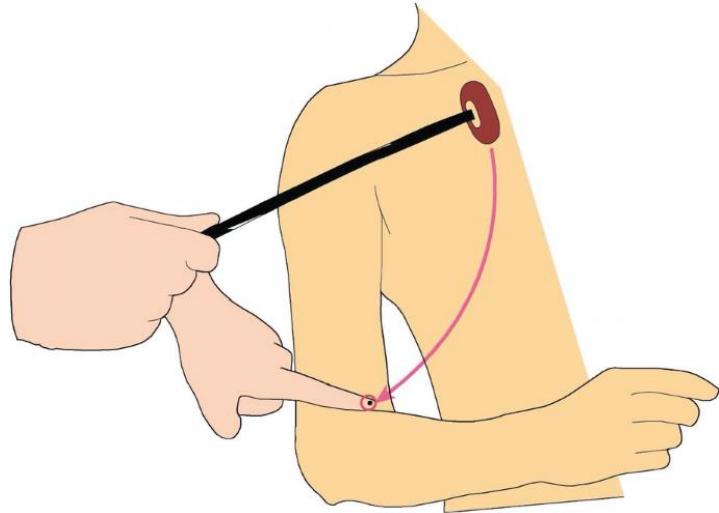
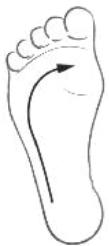
B — Neuro limb
- Look: position (weak leg externally rotated, foot drop; weak hand open, dropped wrist) · wasting · fasciculations · asymmetry, deformity, scars, hair
- Pronator drift · tone · power MRC all joints · reflexes + reinforcement + plantar
- Radicular pain: SLR (supine, knee straight, raise until pain → lower leg + passive dorsiflexion = Bragard, typical ~45°) · femoral stretch (lateral/prone, extend hip + flex knee → anterior thigh pain = upper lumbar/femoral) · PR if saddle anaesthesia/sphincter symptoms
- Sensation: light touch (thighs/forearm, lateral foot) → cotton, pin, compare, peripheral→ascending; vibration + proprioception
- Coordination (finger-nose, heel-shin, dysdiadochokinesia, Romberg) · gait if power ≥3
Cerebellar
- Order: gait (walk, tandem) → Romberg → speech (“British Constitution”, “baby hippopotamus”) → nystagmus → finger-nose → rebound → dysdiadochokinesia → knee reflexes (pendular) → heel-shin
- Signs: nystagmus · dysarthria · pendular knee reflex · loss of coordination · wide-based gait
- Causes: posterior fossa fracture, MS, tumour, abscess, PICA infarct, MSA, paraneoplastic, alcohol, phenytoin, coeliac, Friedreich’s
- vs basal ganglia: cerebellar = awkwardness of intended movement, intention tremor, ataxia; basal ganglia = involuntary/resting tremor, chorea, athetosis, hemiballismus
For the shared neurological examination details, see Motor, Sensory, Gait, and Coordination.
3. Thyroid & neck
Run sheet: WIPER · sitting · neck + upper chest exposed (nipple up — retrosternal goitre) · neck slightly flexed to relax SCM (never extend).
Before the neck
-
Hyperthyroidism → systolic HTN; hypothyroidism → diastolic HTN
-
Hands: onycholysis, warmth, sweating/dryness, thyroid acropachy
-
Pulse: tachy/AF → hyper; brady → hypo; bounding/collapsing → hyper
-
Reflexes: biceps (thumb over tendon, tap) or knee — brisk = hyper; delayed relaxation = hypo
-
Hair/eyebrows: loss, brittleness
-
Eyes: lid retraction, exophthalmos (front, side, behind), lid lag (fix head, finger up/down ×3), periorbital oedema, pretibial myxoedema (waxy, discoloured, non-pitting), eye movements (diplopia/pain)
-
Tongue: macroglossia = hypo · proximal myopathy: stand from sitting with arms crossed
Inspection
- General: cachexia · hoarse voice · dyspnoea/stridor · clothing inappropriate for temperature
- Triangles: anterior = mandible/midline/SCM · posterior = SCM/trapezius/middle third clavicle
- Scars · swelling · neck vein distension · upper-chest veins (SVC obstruction: malignancy, goitre, thymoma, lymphoma)
- Swallow — swelling attached to trachea rises · protrude tongue — thyroglossal cyst rises; thyroid does not
- Mass: site · size · colour · discharge · fistula/sinus · skin breakdown · mobility on head turn (tethering) · fluctuance · punctum · transillumination · bruit
- Don’t mistake scars for folds or cricoid for a mass
Palpation
- Warm hands, narrate; three-finger technique if uncooperative
- Trachea central? ring + index at clavicle heads, middle up midline
- Anterior: tenderness, masses · posterior (explain, behind): upper/middle/lower · never move both hands at once — press one lobe to make the other prominent, then switch
- Thyroid: palmar circular, not deep — right lobe, left lobe, isthmus; sip water, hold, swallow
- Gland: tender (thyroiditis, cyst bleed, carcinoma) · soft normal · firm (simple goitre, Hashimoto) · hard/stony (carcinoma, Riedel’s, calcified cyst) · fixed (malignancy/scar) · thrill (hyperthyroidism, large goitre)
- Consistency by facial landmark: forehead-hard = carcinoma · nose-tip firm/rubbery = benign MNG · chin-soft = colloid/cyst
- Nodule: single/multiple · site/size · well/ill-defined · moves with swallow · compressible/reducible
- Malignancy red flags: age <20 or >60, >35 with hoarseness/dysphagia/trismus/unilateral ear pain/mucosal lesion · childhood neck irradiation · MEN 2A/2B (RET) · rapid growth <1 year
- Subclinical = abnormal TSH, normal free T3/T4 · hot nodule <1 % vs cold 15–20 % malignancy
- Carotid — gently, one at a time (impalpable = compression by goitre or cancer → berry sign; benign goitre displaces it posterolaterally but it stays palpable, superficial temporal pulse palpable)
Percussion & auscultation
- Hand on manubrium at suprasternal notch, fingers abducted; percuss down → dullness = retrosternal goitre
- Confirm: can’t feel lower edge + Pemberton’s (arms to ears 60 s → plethora, cyanosis, distended neck veins, stridor)
- Auscultate bruit (Graves/hypervascular)
- Check legs for oedema/myxoedema → thank, cover → Close
Neck-lump DDx: carotid body tumour (pulsatile at bifurcation, moves side-to-side not vertically, bruit) · laryngocele (reducible, enlarges on Valsalva) · Zenker’s (reducible midline/left, regurgitation, halitosis) · branchial cyst · lymphoma.
6. Abdomen
Indications: DKA, jaundice, ascites, UTI, CKD.
Run sheet: WIPER · supine, one pillow, nipples→mid-thigh (to pubic symphysis) · look (end of bed, then close) → hands/face → palpate (away from pain) → organs → percuss → auscultate → legs/back → completion.
End of bed — ABC₄DₛEV
- Appearance: ill/well, conscious, oriented · B build/BMI · C colour: jaundiced, pale, cyanosed, plethoric
- D distress, decubitus, deformity, dehydration (dry skin/mucosa, sunken eyes)
- E environment: stoma, cannula, NG, O₂, catheter, vomit bowl (“environmentally free”) · V vitals
Look — abdomen
- Shape/symmetry on deep breath · visible pulsation (AAA) · visible peristalsis (obstruction)
- Hernias: cough while watching umbilicus/inguinal; or hand on forehead, resist → bulge
- Skin: scars (name by site), striae, rash, pigmentation, hair · umbilicus central/downward (distension), inverted, everted (hernia/ascites; upward in pregnancy)
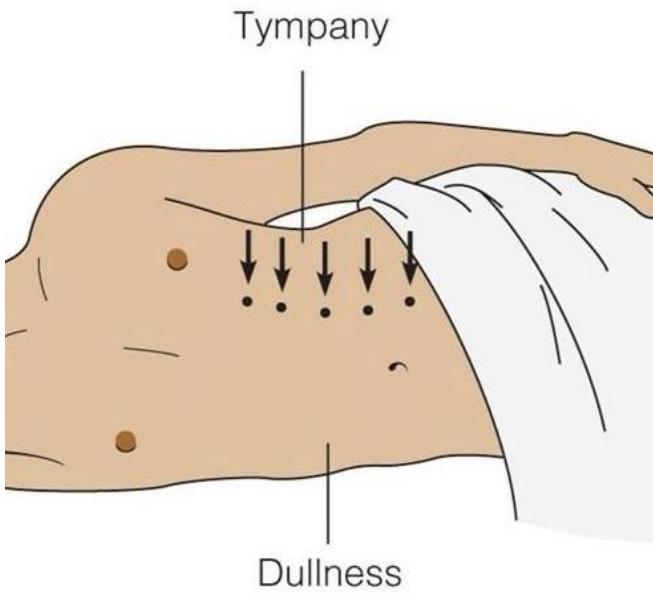
6 Sₛ: symmetrical movement (foot + side at eye level; thoraco-abdominal women, abdomino-thoracic men) · scars · skin lesions · swelling · striae · stoma (right ileostomy, left colostomy). 3 PVₛ: prominent veins (caput medusae = portal HTN) · visible pulsation (AAA) · visible peristalsis. A HUG: distension (6 F’s: fat, fluid, fetus, flatus, faeces, tumour) · hernia · umbilicus · gynaecomastia.
Hands & face (GI focus)
- Nails: clubbing (cirrhosis, IBD, coeliac) · splinter · leukonychia · koilonychia
- Palms: erythema · oedema · Dupuytren (alcohol)
- Arms: asterixis (hands up, wrists extended, hold 30 s; hepatic, uraemic, CO₂ retention) · fine/rest/intention tremor · scratch marks (cholestasis) · bruising/petechiae (thrombocytopenia + ↓factors except VIII/vWF) · deltoid wasting
- Sublingual jaundice · eyes: scleral icterus · conjunctival pallor · xanthelasma · arcus (young = hyperlipidaemia) · Kayser–Fleischer (copper; refer)
- Cheeks: parotid enlargement (alcohol) · submandibular gland enlargement → CLD
- Mouth: angular stomatitis · fetor hepaticus · glossitis · bleeding gums · ulcers (IBD) · buccal pigmentation (Peutz–Jeghers)
- Neck/chest: Virchow node / Troisier (left supraclavicular — gastric/pancreatic) · acanthosis nigricans (insulin resistance, GI cancer) · spider naevi (SVC areas; >5 → cirrhosis) · hair loss · gynaecomastia
- Legs: pitting oedema, bruising
Palpate
- Warm hands · 9 regions · ask pain, start away · palmar surface · watch face
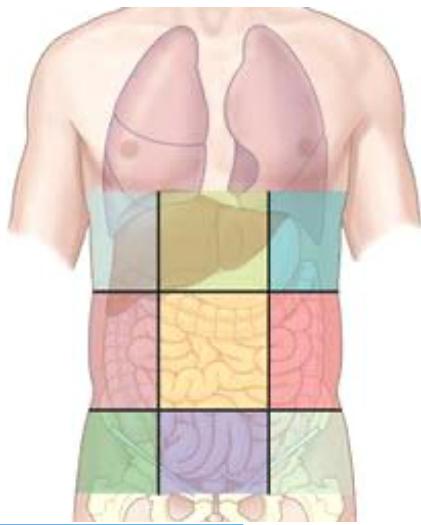
- Superficial (anticlockwise): tenderness · guarding (voluntary) · rigidity (involuntary + tender = peritonitis)
- Deep: masses (site, size, shape, consistency, mobility, pulsation, tenderness) · rebound · Rovsing · psoas · Murphy
- Organ technique: start RIF, lateral border of index, move in expiration, hold in inspiration
Liver
Courvoisier’s law: jaundice + enlarged non-tender gallbladder ⇒ malignant distal CBD obstruction (exceptions: double impaction, Mirizzi, choledochal cyst).
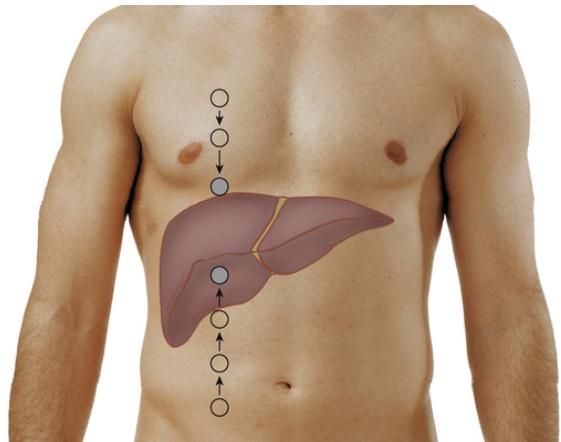
- Right lobe: RIF → costal margin; describe surface, consistency, edge, tenderness · left lobe: epigastrium below xiphoid
- Span: percuss down right MCL from 2nd ICS to upper dullness (~6th rib), then up from RIF to lower border. 6–12 cm / 12±2 male, 10±2 female
Spleen
- Diagonal RIF → left hypochondrium; palpable at costal margin ≈3× normal (any palpable spleen ≥2×); moves down and medially on inspiration
- Subclinical: percuss right 8th–10th ICS — dull = splenomegaly (fast ≥2 h)
Spleen vs left kidney
- Upper border: kidney palpable · spleen not · Notch: kidney no · spleen yes · Movement: kidney inferiorly · spleen inferomedially · Ballotable: kidney yes · spleen no · Percussion: kidney resonant · spleen dull · Rub: kidney no · spleen yes
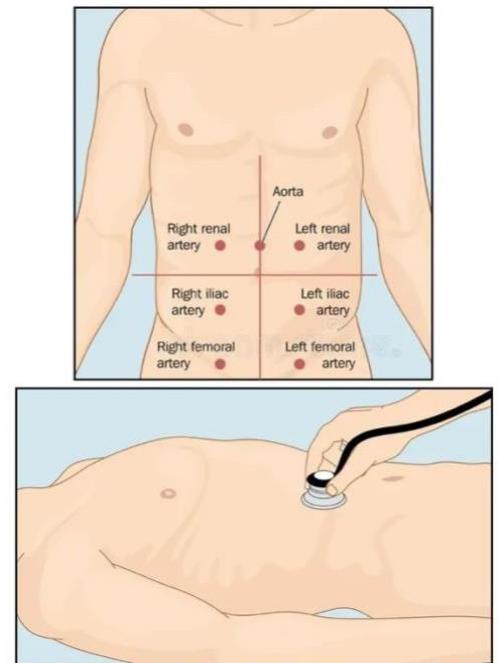
Kidneys: right hand anterior, left posterior (don’t switch); push up, feel poles = ballottement. Palpable kidney causes: PCKD, hydronephrosis, RCC, amyloid, (Wilms), HTN. Aorta: gentle 2–3 cm above umbilicus · grade impulse: none / transmitted / expansile (AAA). Dipping in ascites · Murphy’s (fever + RUQ pain + jaundice: hand as kidney, deep breath + exhale as you reach subcostal margin → stops exhaling). Renal punch: fist over placed hand, gentle (pyelonephritis/transplant).
Percuss
- Midline xiphoid → down: resonant; dull = mass/massive ascites; hyper-resonant = distension · loss of liver dullness = free air/perforation · don’t percuss below umbilicus (bladder)
- Umbilicus → flank to dullness → roll toward you → wait 10–30 s → percuss back = shifting dullness (more sensitive, mild)
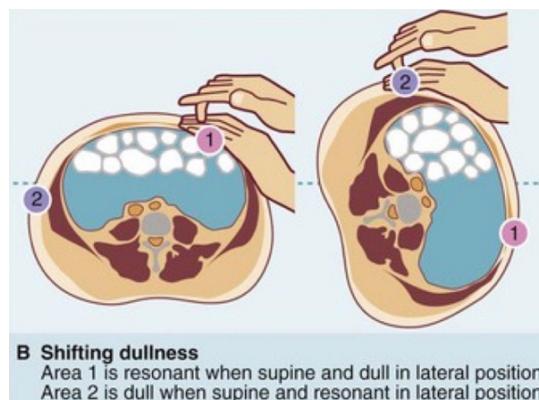
- Fluid thrill (more specific, massive): palm edge midline, left palm flat opposite, flick → wave
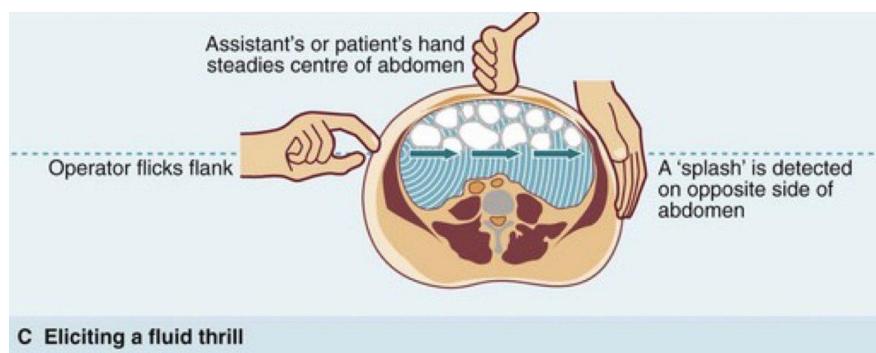
- Fixed dullness that doesn’t shift = mass/massive ascites
- Castell’s: dull 8th–9th ICS left anterior axillary line, or becomes dull on inspiration = splenomegaly (Traube’s)
- Kidney masses resonant
Auscultate
- Bowel sounds (diaphragm) — McBurney then 4 quadrants; 5–10 s/2–3 min · absent 2–4 min = ileus/obstruction · hyperactive = obstruction/gastroenteritis · splash = obstruction · succussion splash = retained gastric fluid (pyloric/gastric outlet obstruction)
- Friction rub: diaphragm liver, bell spleen = peritoneal inflammation
- Venous hum (bell): xiphisternum→umbilicus = portal HTN · hepatic bruit = HCC/vascular tumour
- Renal bruits (bell): either side above umbilicus = renal artery stenosis; also aortic/iliac
Abdomen — finish
- Legs: oedema, scratches, pigmentation, vasculitis · back: masses, scars, rash
- Say you’d do: nodes, genitalia, PR, dipstick, vitals, fundoscopy · β-hCG in any reproductive-age woman before imaging/surgery
- Examine hernial orifices → thank → cover → Close
Special tests
Murphy (cholecystitis) · Rovsing, psoas, obturator (appendicitis) · Cullen, Grey Turner (pancreatitis) · Fox’s sign = upper-thigh ecchymosis (retroperitoneal bleed) · Sister Mary Joseph nodule.
Scar map
A midline · B paramedian (kidney, adrenals, spleen) · C subcostal (biliary, spleen) · D chevron (gastrectomy, adrenalectomy, liver) · E loin · F McBurney · G Lanz · H Pfannenstiel (lower GIT, urinary, reproductive, caesarean) · liver transplant Mercedes-Benz · renal transplant RIF · McBurney injures iliohypogastric/ilioinguinal → conjoint tendon weakness → iatrogenic direct hernia.
Histories
10. Histories
Use the 11-step spine (§1) for every history; below are only the complaint-specific questions, discriminators and theory. Always: intro/consent → personal data → CC + duration → HPI (SOCRATES/OPERATES) → systems → PMH/PSH → drugs/allergy → family → social (2nd consent) → ROS → thank → summarise.
GI bleeding
- Bleeding: amount, colour, frequency; clots? food? · haematemesis vs haemoptysis (cough/vomiting, acid/alkaline) · coffee-ground = acidified · bruising elsewhere 2 months → bleeding disorder/leukaemia
- Onset: haematemesis usually acute; melena appears 2–3 days later · progression, triggers, anything that slowed it
- PR: dark tarry offensive sticky (melena) vs fresh · pain on defecation (fissure) vs painless (haemorrhoids unless thrombosed) · blood covering or mixed with stool
- Retching before vomiting → Mallory-Weiss (alcohol + heavy meal, repetitive projectile vomiting, tear in lower oesophagus, endoscopy, may need transfusion)
- Upper GI: dyspepsia, nausea, vomiting, dysphagia, mouth ulcers, GERD (burning, night cough, metallic taste) · Lower GI: diarrhoea, alternating habit (cancer), tenesmus, food history (dysentery)
- Anaemia/dehydration: SOB (elderly), fatigue, dizziness, low urine output · constitutional: fever, night sweats, weight loss
- PMH: liver disease/portal HTN/oesophagitis · bleeding, transfusions + reactions · previous episodes · surgery, cancer · radiotherapy (radiation colitis) · menstrual cycle, pregnancy
- Drugs: NSAIDs (OTC or prescribed → erosive gastritis), steroids, anticoagulants (INR), bisphosphonates
- Family: similar presentation, chronic disease, TB, polyps/colorectal cancer · Social: education/job, travel (dysentery, giardia), smoking/alcohol + willingness to quit, sexual history, support
- Definitions: haematemesis (fresh red, upper) · coffee-ground · melena (black tarry offensive, upper/proximal) · haematochezia (fresh PR; massive upper bleed can present this way)
- Above ligament of Treitz = upper; below = lower · black stool also from iron (ferrous sulphate)
- Epigastric pain DDs: peptic ulcer, duodenal ulcer, gastritis, gastric erosion, gastric cancer · DU vs GU: DU — hunger pain 2–3 h post-prandial, nocturnal 1–2 am, relieved by food · GU — pain worsened by food → food avoidance, weight loss
- Varices: dilated veins, painless; portal HTN (bilharziasis, cirrhosis), alcoholic liver disease (HBV, HCV), transfusion (HBV, HCV)
- DD: upper — PUD, varices, erosive gastritis (NSAIDs), Mallory-Weiss, aortoenteric fistula, angiodysplasia, haemobilia · lower — haemorrhoids/fissures, diverticular disease, colorectal cancer, infectious colitis/dysentery, rectal varices, angiodysplasia
- Ix: CBC, coagulation PT/INR, LFT, BUN/creatinine (BUN rises disproportionately in upper bleed); EGD (upper), colonoscopy (lower), CT angio if massive/unclear, NG lavage · marrow biopsy if bruising/systemic symptoms suggest leukaemia
- Exam: pallor + scattered bruises/scabs (elbow, wrist, feet, mouth), cachexia alongside chronic liver disease signs
- Rx: ABC → IV fluids, type & crossmatch if unstable, IV PPI, octreotide ± antibiotics if variceal, endoscopic haemostasis, correct coagulopathy, surgical consult
- ER: 2 wide-bore needles, Ringer’s, NG decompression, Foley, labs (CBC, LFT, crossmatch) → saline then blood · varices → vasopressin/octreotide (chest pain → nitrate) · ulcer → IV PPI
- Endoscopy: varices → band/sclerotherapy (ethanolamine); ulcer → adrenaline, clips, thermal
- Unstable: Sengstaken-Blakemore tube → perforation, ulceration, asphyxiation (cut the tube)
Chest pain
-
Site: IHD retrosternal/precordial (rarely only left shoulder) · pericarditis precordial · PE/MSK anywhere · pleuritis over affected pleura · herpes zoster (dermatomal, doesn’t cross midline, pain before rash)
-
Onset: IHD sudden after exertion (or rest if unstable) · pericarditis gradual, not exertional · PE sudden · MSK after trauma/lifting · pleuritis with infection
-
Character: IHD pressure/squeeze · pericarditis pricking/sharp · PE sharp/stabbing · MSK dull · pleuritis sharp
-
Radiation: IHD neck, jaw, left shoulder, interscapular (may be absent) · others none
-
Associated: IHD nausea, sweating, dizziness, palpitations, dyspnoea · pericarditis fever (preceding URTI) · PE palpitations, dizziness, dyspnoea, syncope · pleuritis fever
-
Duration: angina 2–20 min · MI ~30 min constant (settling pain may mean completed infarct) · pericarditis continuous · MSK persistent
-
Worse/relieved: IHD worse exertion, better rest, nitrates help angina not MI · pericarditis worse supine, better leaning forward, ↑ deep breath/cough, NSAIDs · PE worse inspiration · MSK worse movement/lifting · pleuritis worse inspiration/cough
-
Also: reproducible chest wall (costochondritis) · after meals/lying flat, antacids help (GERD) · oesophageal spasm mimics angina, responds to GTN · severity 1–10
-
Hypoperfusion: dizziness, fatigue, syncope, cold sweats, low urine output · constitutional: fever, night sweats, weight loss
-
PMH: HTN, dyslipidaemia, DM, prior IHD/similar pain, rheumatic fever/murmur, stroke/TIA, autoimmunity (SLE, RA), anaemia, DVT/PE, MI/stenting/angiogram, recent surgery, malignancy, radiotherapy, recent viral illness; pregnancy; premenopausal oestrogen lowers ACS probability
-
Drugs: anticoagulants/antiplatelets (compliance), INH, pyrazinamide, hydralazine (drug pericarditis), OCPs
-
Family: early CAD/sudden death · HTN/DM/connective tissue disease (Marfan → dissection) · TB (pericardial calcification) · familial hypercholesterolaemia
-
Social: job · long-distance travel (DVT/PE) · smoking/alcohol · cocaine/amphetamines (MI, dissection)
-
Stop → ABCD if massive pain with shock
-
Not chest-pain causes: pleural effusion, endocarditis, heart failure, arrhythmias, CKD
-
Theory: ACS, dissection, pericarditis, pneumonia and other causes → §14.
Jaundice
- Causes: pre-hepatic — haemolytic anaemia (sickle cell, G6PD, hereditary spherocytosis), Gilbert · hepatic — hepatitis A/B/C, autoimmune, drug-induced, liver abscess, HCC, cirrhosis · post-hepatic — CBD stone, pancreatic head carcinoma
- Onset: self-noticed or pointed out? sudden/gradual · duration long/insidious in chronic liver disease, acute in hepatitis/stone
- Progression: deeper/constant → malignancy/severe obstruction; fluctuating → Gilbert or migrating gallstone
- Severity: sclera >3 mg/dL · face >5 · whole body ~22
- Triggers: fasting, dehydration, illness, stress (Gilbert resolves with IV fluids)
- Urine dark/tea/cola (conjugated) · stool pale/clay (obstruction) · haemolytic = normal urine and stool (acholuric, unconjugated) · pruritus severe (bile salts)
- Pain: severe colicky RUQ (gallstones) vs dull, constant, diffuse (malignancy/parenchyma)
- GI: nausea, vomiting, distension, early satiety, diarrhoea, bowel change · haemolytic jaundice lacks nausea/vomiting/anorexia/fever/pain/weight loss
- Neuro/psych (Wilson’s): tremor, clumsiness, involuntary movements, mood/behaviour change
- Fever: low grade (hepatic/malignancy) vs high spiking with chills = Charcot’s triad (ascending cholangitis); + hypotension + confusion = Reynolds’ pentad → urgent ERCP
- Pseudo-jaundice: carotenaemia (yellow palms/soles, sclera spared, no bilirubinuria)
- Weight loss: intentional? (on Mounjaro/tirzepatide, expected or disproportionate with fatigue?) · significant → liver/pancreatic carcinoma, cirrhosis
- PMH: gallstones, cirrhosis, HBV/HCV, autoimmunity, previous anaemia/haemolysis, transfusions, previous jaundice, cholecystectomy/gastric/pancreatic surgery, malignancy, radiotherapy, pregnancy (fatty liver, intrahepatic cholestasis)
- Drugs: GLP-1, paracetamol, statins, amoxicillin-clavulanate, flucloxacillin, rifampicin, anabolic steroids, herbals (DILI)
- Family: fluctuating jaundice (Gilbert), early liver/neuro disease (Wilson), liver disease/haemolytic anaemia (G6PD, thalassaemia), viral hepatitis at home, autoimmune, haemochromatosis, α1-antitrypsin deficiency
- Social: job/chemicals · travel to endemic areas, contaminated food/water, mosquitoes · smoking/alcohol · sexual history, IVDU, unsterile injections, tattoos, jaundice in spouse/partner
- ROS: SOB/palpitations (haemolysis) · urine output/colour · joint pain/rash (autoimmune hepatitis, SLE)
- Patterns: pre-hepatic — fluctuating, resolves with fluids, worse morning → Gilbert; fava beans/drugs → G6PD · hepatic — acute, RUQ pain, dark urine, travel, rash → hepatitis A/autoimmune/DILI · post-hepatic — progressive, cachexia, weight loss → pancreatic CA/cholangiocarcinoma; colicky RUQ, itch, pale stool → choledocholithiasis · metabolic — tremor/dystonia/psychiatric → Wilson’s
- Exam: scleral icterus, hepatomegaly/splenomegaly, ascites/oedema, spider naevi, palmar erythema, gynaecomastia
- Ix: LFTs (post-hepatic: direct bilirubin >50 % total, ALP/GGT >3–5× ULN, mild AST/ALT; hepatocellular: AST/ALT >500–1000), viral serologies, US/MRCP, coagulation · total bilirubin >3–4 mg/dL ⇒ suspect choledocholithiasis or Mirizzi (stone in Hartmann’s pouch compressing CHD)
- Rx: treat cause (antivirals, ERCP for obstruction), supportive, transplant if end-stage · obstructive: fat-soluble vitamin (A/D/E/K) deficiency → ↓II/VII/IX/X and prolonged PT; give vitamin K 10 mg IV/SC before procedures