Table of Contents
-
Types of Glaucoma
Primary:
- A. Congenital Glaucoma
- B. Hereditary (infantile)
- C. Adult Glaucoma (common types)
-
Evaluation of Glaucoma
-
Treatment of Glaucoma
Professor of Ophthalmology Dr. Amani Badawi
Glaucoma

GLAUCOMA
A progressive optic neuropathy with characteristic optic nerve head and nerve fiber layer changes and visual field changes. In most cases, damage to the optic nerve is due to increased pressure in the eye (intraocular pressure - IOP).
PROGRESSION
- Ganglion cell death
- Retinal nerve fiber layer changeD
- Optic nerve head changes
- Visual field changes
IOP
- “Normal eye pressure” is not a stable number(s), it ranges from 10 to 21 mmHg.
- Elevated IOP is an eye pressure of “greater than 21 mmHg”.
- Diurnal fluctuation normally < 6 mmHg.
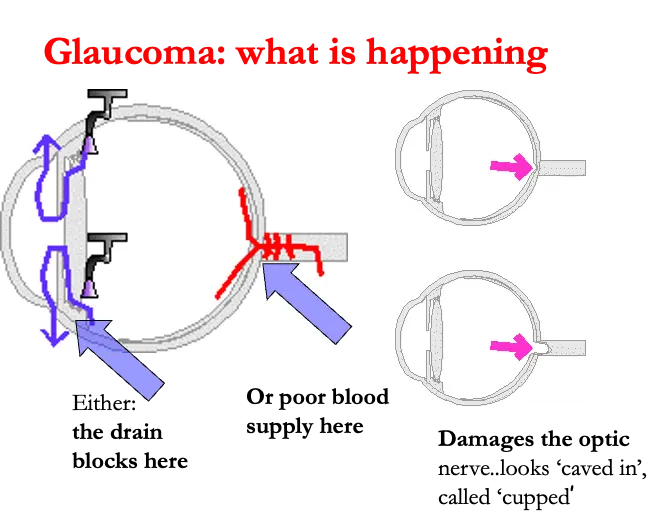
Glaucoma: What is Happening
-
Either:
- The drain blocks here.
-
Or poor blood supply here.
-
Damages the optic nerve…looks ‘caved in’, called ‘cupped’.
Characteristic Pattern to Loss of Visual Field
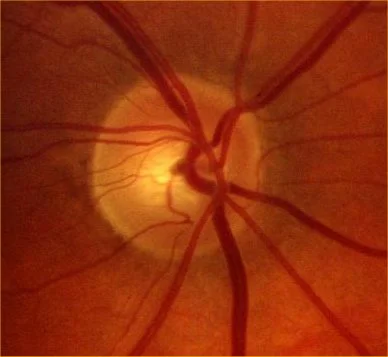
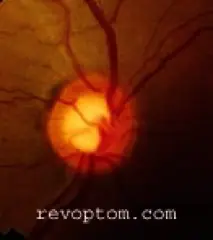
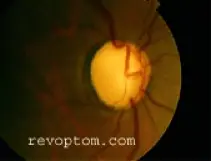
- Rim of optic nerve becomes thinner as disc caves in and becomes more cupped.
Glaucoma
- A major cause of blindness. African Americans
- Often asymptomatic; in early stage (peripheral vision)
- Damage is irreversible
- Effective treatment is available
Types of Glaucoma
- Open Angle
- Closed Angle
American Academy of Ophthalmology
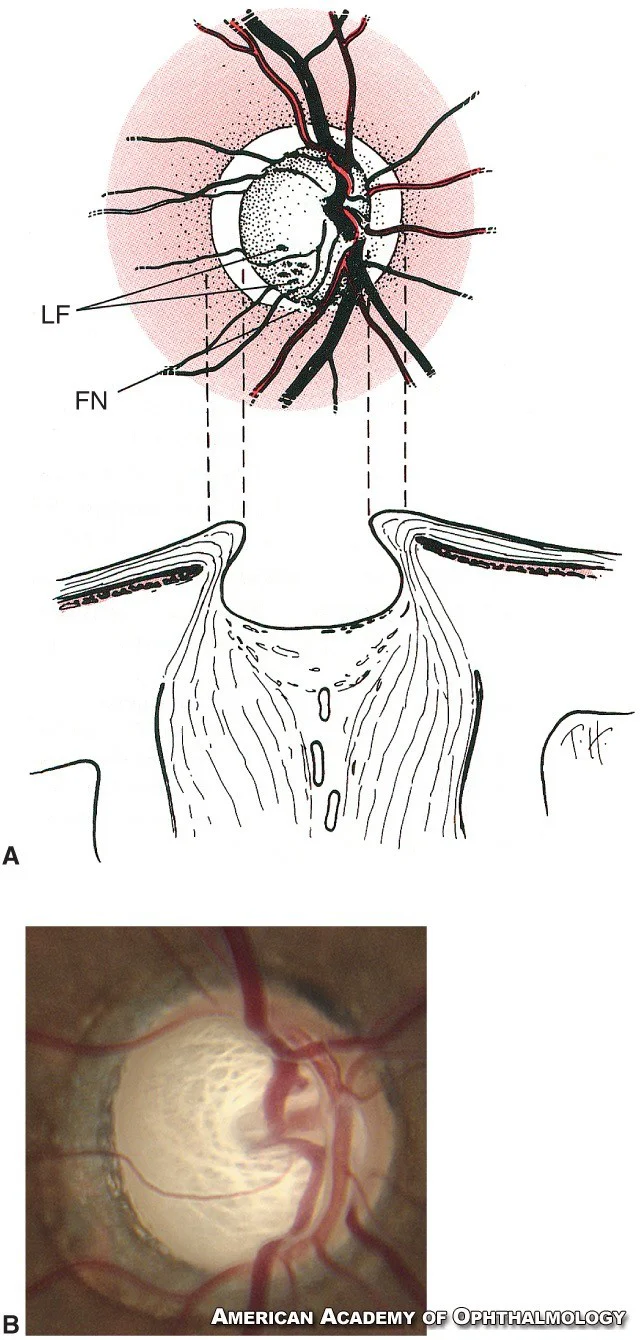 disc cupping = glaucoma