Approach to Patient with Thyroid Disorders
Objectives
At the end of this session, students will be able to:
- Identify differential diagnosis of a case presented with the symptoms of tiredness.
- Identify differential diagnosis of thyroid swellings.
- Differentiate between different causes of thyroid swellings.
- Discuss briefly about hypo and hyperthyroidism symptoms.
- Investigate appropriately a patient with generalized tiredness.
- Investigate appropriately a patient with thyroid swelling.
- Advise initial management plan for a patient with hypothyroidism
- including sub-clinical hypothyroidism.
Tiredness Or Fatigue
- Tired all the time is a popular phrase given by patients to their family doctors.
- Tiredness or fatigue is a common problem. Often, it is not a medical issue but one that can be reversed by a change of lifestyle.
Organic Causes of Fatigue
- Infectious causes
- Anemia
- Endocrinopathies (e.g., diabetes and hypothyroidism)
- Sleep disturbances (e.g., sleep apnea)
- Medication side-effects
- Adrenal insufficiency
- Malignancies.
Thyroid Gland
Thyroid Diseases
Functional disorders:
-
1. Hypothyroidism - Hypofunction
-
2. Hyperthyroidism - Hyperfunction
Nodular abnormalities:
- Goitre
Tumors:
Thyroid Examination
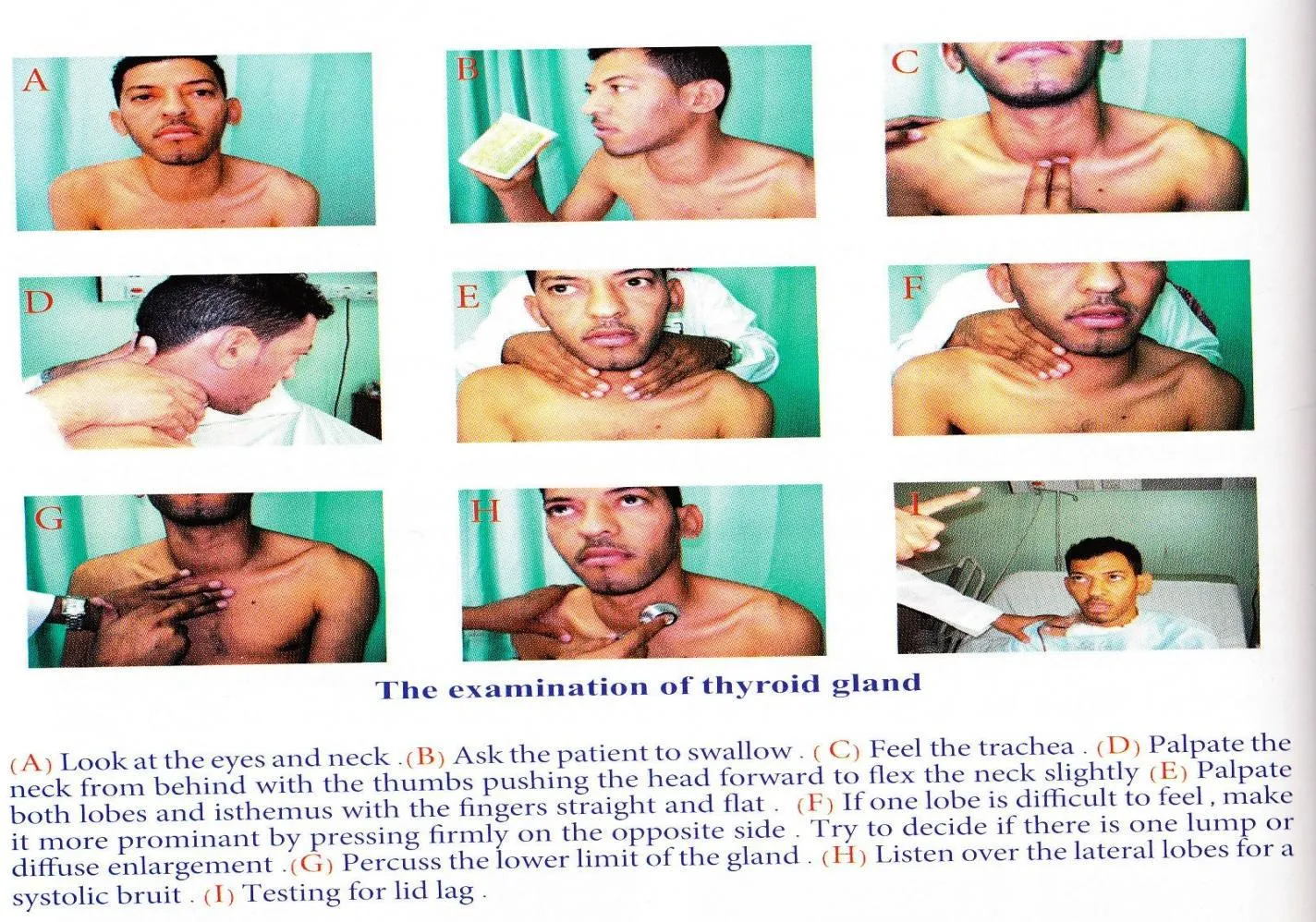
- The examination of thyroid gland
- (A) Look at the eyes and neck.
- (B) Ask the patient to swallow.
- (C) Feel the trachea.
- (D) Palpate the neck from behind with the thumbs pushing the head forward to flex the neck slightly.
- (E) Palpate both lobes and isthmus with the fingers straight and flat.
- (F) If one lobe is difficult to feel, make it more prominent by pressing firmly on the opposite side.
- Try to decide if there is one lump or diffuse enlargement.
- (G) Percuss the lower limit of the gland.
- (H) Listen over the lateral lobes for a systolic bruit.
- (I) Testing for lid lag.
Clinical Presentation of Thyroid Problems
-
Chief complaint:
- Swelling in the neck (+/-), or only symptoms of hyper or hypothyroidism.
-
History of the presenting illness:
- Swelling: Compressing symptoms:
- --- Dyspnea.
- --- Difficulty in swallowing.
- --- Hoarseness of the voice when the recurrent laryngeal nerve is involved. Whistling of air sounds (stridor): heard when it compresses the trachea.
- Swelling: Compressing symptoms:
- Symptoms of hyper or hypothyroidism.
Risk factors:- Exposure to radiation.
- Family history.
- Iodine intake.
- Previous disease.
CASE SCENARIO (Thyroid Swelling)
- A 40-year-old lady is a secretary in a private company. She presented today with her husband complaining of a six months history of generalized fatigue, feeling tired easily, and tingling in her hands during her work and at night.
- She mentioned that she has gained weight about 10 kg over six months.
- She also complained that her periods had become irregular and lighter than previously.
- Her husband had also commented that she had developed a deeper, croaky voice.
On Examination:
- She looks well, not pale or jaundiced. She was overweight (BMI= 29) with generally dry skin and thin and coarse hair. Pulse was 60/min, but regular. She had swelling in the thyroid gland, which was mild and smooth, no pulse or bruit were heard over the swelling. The knee jerk had slow relaxing reflex. She also had evidence of bilateral carpal tunnel syndrome.
Laboratory Investigations:
- Thyroid-stimulating hormone (TSH) was increased: 28U/ml (normal <4)
- Thyroid hormone (T4) was low: 9 mol/l.
- Antibodies to thyroid peroxidase were present at high titer.
References
- Hypothyroidism: An Update; American Family Physician
- American association of clinical endocrinologists medical guidelines for clinical practice for the evaluation and treatment of hyperthyroidism and hypothyroidism