The Cornea
Professor of Ophthalmology Dr. Amani Badawi
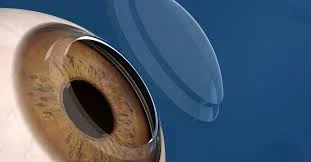
Gross Anatomy
-
Anterior 1/6 of outer coat
-
Transparent & No BVs
-
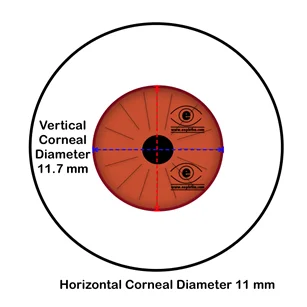
Diameter:
- Horizontal 12 mm
- Vertical 11 mm
-
Thickness:
- Central 0.5 - 0.6 mm
- Peripheral 0.8 - 1.0 mm
-
Refractive Power: 42 D
-
What is The LIMBUS?)
Vertical Corneal Diameter 11.7 mm Horizontal Corneal Diameter 11 mm
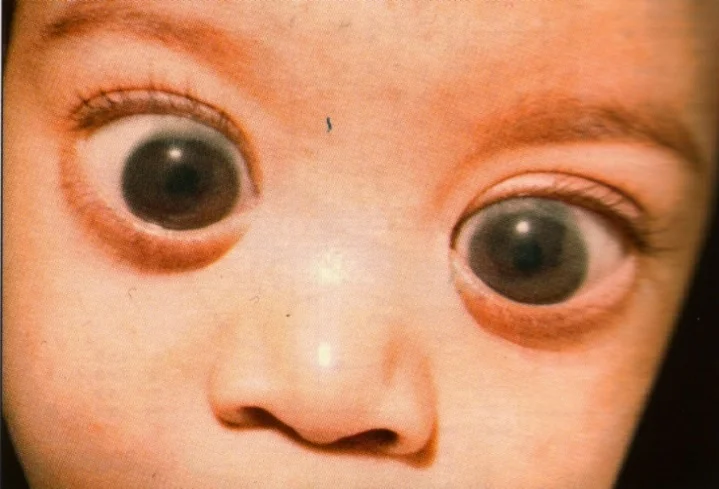
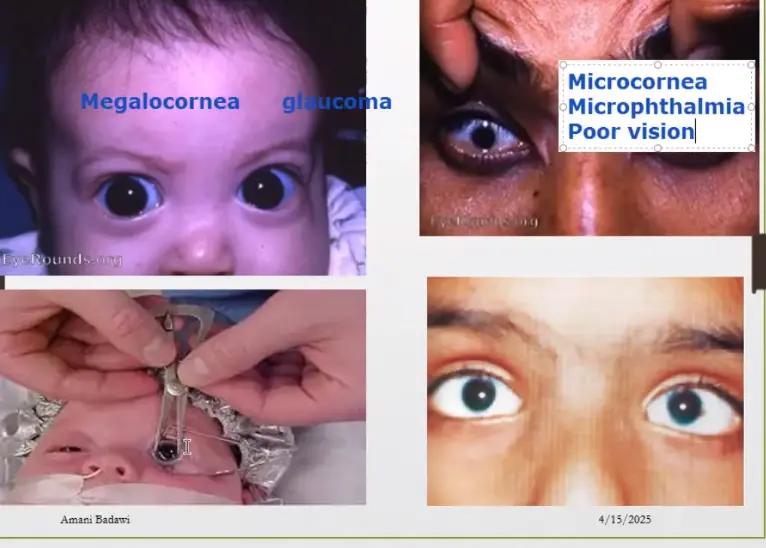
Minute Anatomy
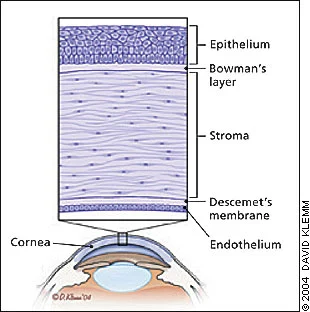
6 LAYERS
-
Epithelium
- St. Squamous Nonkeratinised
- (5-6 layers), 50 microns
-
Bowman’s layer
- Structureless (Acellular) condensation
- Never regenerate
-
The Stroma - 90% of corneal thickness - C T Bundles (Regular arrangement) - 500 microns thick
-
Descemet’s Membrane
- Homogenous, Structureless & Highly Elastic
- Resistant & Easily Regenerate
- 5 microns thick in children and 15 microns thick in older adults.
-
Corneal Endothelium
- One Layer of Polyhedral cells
- Partial dehydration of the cornea
- Continuous with the Endothelium Trabecular meshwork (T M).
- About 5 microns.
- Dua Layer (Newly Discovered) Z
- Discoverer by Harminder Dua 2013.
- Strong layer between the corneal stroma and Descemet’s membrane
- 15 microns thick
Nerve Supply of the Cornea 5th C.N

Corneal Physiology
NUTRITION (cornea is avascular)
- By diffusion
- Tear Film
- Aqueous humour
- Limbal capillaries
CORNEAL TRANSPARENCY (WHY)
Anatomical Factors:
- Cornea is avascular
- Stromal lamellae are regular
- Nerves are nonmyelinated
- Precorneal tear film
Physiological Factors:
- Corneal dehydration
- Uniform refractive indices of corneal tissue
FUNCTIONS OF THE CORNEA
- Refractive 42 D
- Protective (corneal reflex)
The Limbus (The Corneo-Scleral Junction)
- Corneal epithelium → Conjunctival epithelium
- Bowman’s membrane ends as a rounded border
- Stroma → Sclera (irregular lamellae)
- Descemet’s membrane → Trabecular meshwork
- Endothelium → Endothelium of the angle of AC
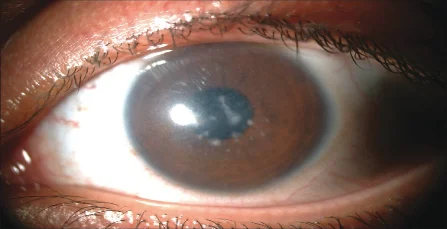
Corneal Diseases
Keratitis
-
KERATOS
- Cornea
-
iTiS
- Inflammation
-
Superficial keratitis
- Suppurative (Corneal Ulcer)
- Non Suppurative (Pannus)
-
Interstitial keratitis
-
Deep keratitis
Corneal Ulcers
Primary Corneal Ulcers
-
Infected Corneal ulcer
- Hypopyon Ulcers (Bacterial)
- Herpetic Ulcers (Viral)
- Mycotic Ulcers (Fungal)
- Acanthamoeba Keratitis (Protozoa)
-
Non-Infected Corneal ulcer
Secondary Corneal Ulcers
- Keratomalacia
- Atheromatous Ulcer
- Ulcer with Lagophthalmos
- Neuroparalytic Ulcer
- Traumatic Ulcer
Degenerative Conditions
Management
Quiz 1
Put “True” or “False” in the following statement:
About Hutchinson’s rule;
-
Hutchinson’s rule signifies increased risk of conjunctivitis & keratitis.
-
Hutchinson’s rule signifies increased risk of Uvietis
-
Vesicles on the tip of the nose, because the frontal branch of the trigeminal nerve.
-
Provisional diagnosis of Herpes simplex Ophthalmicus.
Quiz 2
Give differences between bacterial and fungal corneal ulcers.
Z local general predisposing #Z most common side effect glacoma from topical steroids or increased intraocular pressure PPLV Corneal Ulcer Z FT Z to confirm diagnosis
3 months boy suffering from wide pupil in left eye