Bipolar Disorder
MED 2017
Objectives
- Learn how to make the diagnosis of bipolar in a time efficient manner
- Learn how to use psychopharmacology to treat Bipolar Disorder, using current guidelines
- Learn about issues of psychopharmacology and pregnancy
Table of contents
Bipolar Disorder
MANIC
- 7 days or more, unless hospitalized
- Interferes with life greatly
- Increased mood
- Increased energy
- Decreased sleep
HYPOMANIC
-
4 days or more
-
Somewhat interferes with life, seen by others as uncharacteristic
-
Same features as manic, no marked impairment in functioning
-
IMPORTANT: Separate Bipolar II from Axis II, cluster B mood lability
- Remember time line, days vs. hours or a day
- Out of the blue vs. response to stressors
Bipolar I vs. Bipolar II
Bipolar I
- Manic phase(s) +/- depression phase(s)
- 1% lifetime prevalence
Bipolar II
- Hypomanic phase(s) + depression phase(s)
- 1.1% lifetime prevalence

Bipolar Disorder
- Mean age of onset - early to mid 20’s
- Peak age is 15-19
- Usually 3-10 year lag between onset and treatment
- Initially
- Depression in women
- Mania in men
- Twin studies and first degree relative studies support the fact of heritability

Bipolar Terms
- Bipolar
- Manic phase
- Hypomanic phase
- Depressed
- Mixed phase - depression and mania essentially coexist, switching over hours, or every 1 - 2 days. Also has been called ultra rapid cycling. Must last at least one week. Causes marked impairment in functioning.
- Rapid Cycling
- 4 or more episodes/year
- Going from manic to depressed - counts as two episodes
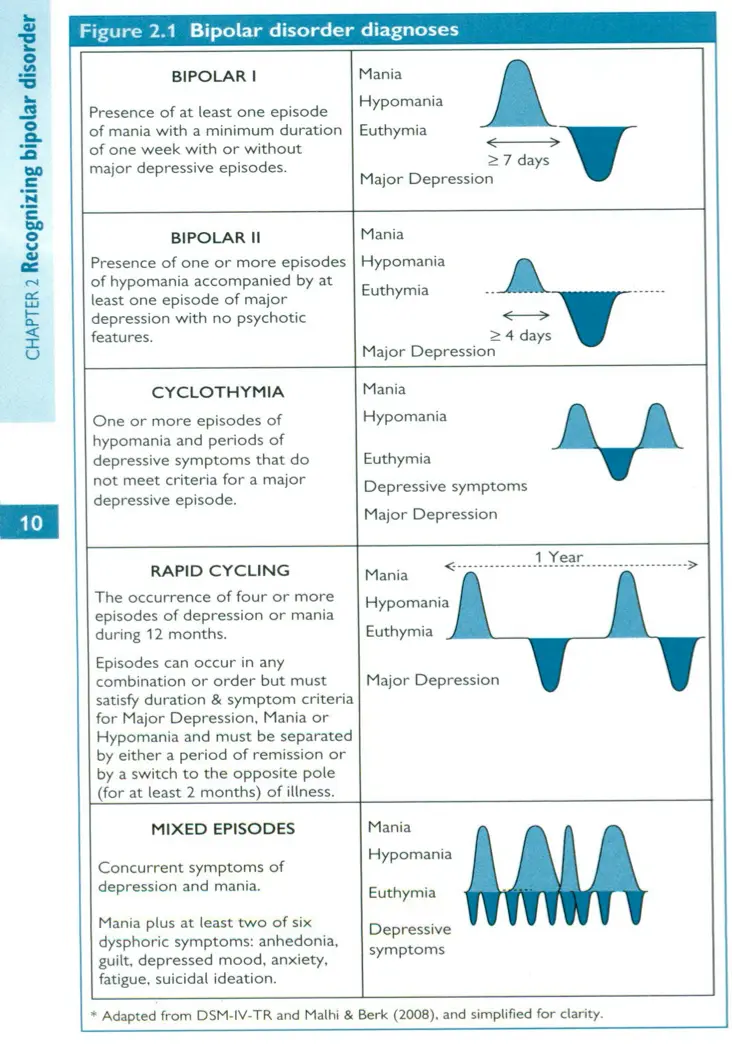
Figure 2.1 Bipolar disorder diagnoses
- BIPOLAR I
- Presence of at least one episode of mania with a minimum duration of one week with or without major depressive episodes.
- BIPOLAR II
- Presence of one or more episodes of hypomania accompanied by at least one episode of major depression with no psychotic features.
- CYCLOTHYMIA
- One or more episodes of hypomania and periods of depressive symptoms that do not meet criteria for a major depressive episode.
- RAPID CYCLING
- The occurrence of four or more episodes of depression or mania during 12 months.
- Episodes can occur in any combination or order but must satisfy duration & symptom criteria for Major Depression, Mania or Hypomania and must be separated by either a period of remission or by a switch to the opposite pole (for at least 2 months) of illness.
- MIXED EPISODES
- Concurrent symptoms of depression and mania.
- Must also be at least two of six of the following:
- Mania
- Hypomania
- Euthymia
- Depressive symptoms
- Major Depression
THINGS TO DO:
- Assess for organicity
- Harm to others (e.g., driving)
- EtOH/Substance abuse
- High co-morbidity rate
- Can worsen
- Suicidality
- 17-19% lifetime prevalence of completed suicide
- More often in depressed state
- Educate
- Inadequately treated patient may have 10 or more episodes
- Intervals between episodes narrows as person ages
- Sleep deprivation can provoke hypomanic/mania
Disability Issues
- Stable bipolar is not disabling
- Most people should hit their normal “life arc”, including working
- Let patients know this!
- A minority of treatment resistant cases may require disability
